| Family: |
Liparidae (Snailfishes) |
| Max. size: |
Deprecated: strlen(): Passing null to parameter #1 ($string) of type string is deprecated in /var/www/html/FieldGuide/FieldGuideSummary.php on line 616
54 cm TL (male/unsexed); max.weight: 1,700.0 g; max. reported age: 8 years |
| Environment: |
bathydemersal; marine; depth range 50 - 2453 m |
| Distribution: |
North Pacific: Bering Sea to off San Diego in California, USA. |
| Diagnosis: |
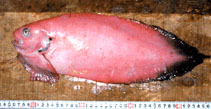
Dorsal spines (total): 0-0; Dorsal soft rays (total): 54-58; Anal spines: 0-0; Anal soft rays: 37-50. Dorsal fin extending about halfway along length of caudal fin; caudal narrow, slightly rounded; lower 6 rays of pectorals slightly thickened and completely exserted, the next 5 greatly to moderately exserted and longer than the rays immediately above them, no real notch in fin; pelvic fins modified to form a small adhesive disc with a thickened margin, placed far forward, below eye (Ref. 6885). Off-white to pale rose on body; ends of pectoral and edges of posterior parts of dorsal and anal, and most of the caudal, black; lining of mouth and gill cavity, and tongue black (Ref. 6885). |
| Biology: |
Found on mud bottoms (Ref. 2850). Possibly the most commonly captured liparid below 200 m; captured frequently by fishers (Ref. 26773). Known to feed on polychaete worms, small crustaceans, tiny clams and other invertebrates (Ref. 4525). |
| IUCN Red List Status: |
Not Evaluated (N.E.) Ref. (130435)
|
| Threat to humans: |
harmless |
Source and more info: www.fishbase.org. For personal, classroom, and other internal use only. Not for publication.