| Family: |
Catostomidae (Suckers), subfamily: Catostominae |
| Max. size: |
Deprecated: strlen(): Passing null to parameter #1 ($string) of type string is deprecated in /var/www/html/FieldGuide/FieldGuideSummary.php on line 600
Deprecated: strlen(): Passing null to parameter #1 ($string) of type string is deprecated in /var/www/html/FieldGuide/FieldGuideSummary.php on line 616
4.42 cm SL (male/unsexed) |
| Environment: |
benthopelagic; freshwater; brackish |
| Distribution: |
North America: coastal streams and lakes from the Siuslaw River south to the
Sixes rivers in Oregon, USA. |
| Diagnosis: |
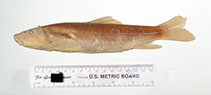
Dorsal soft rays (total): 9-12. Distinguished from all other species of Catostomus by having the following combination of characters: 65-80 scales on lateral line; 9-12 dorsal fin with rays; 14-38 infraorbital pores; gill 24-31 gill rakers in specimens >20 cm SL; gill rakers with spines in clusters; caudal peduncle depth 6.4-9.3% SL; lateral fields of scales with either no radii or extensions of anterior radii; and foramen for the ninth cranial nerve between the exoccipital and prootic (Ref. 87374). |
| Biology: |
Found in coastal streams and lakes as well as in brackish water. Observed in large schools, following the tide and venturing some distance into brackish water . Spawns over gravel and cobble (Ref. 87374). |
| IUCN Red List Status: |
Not Evaluated (N.E.) Ref. (130435)
|
| Threat to humans: |
harmless |
Source and more info: www.fishbase.org. For personal, classroom, and other internal use only. Not for publication.