
|
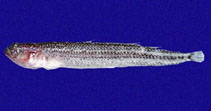
Dactyloscopus fimbriatus (Reid, 1935) |
|
|
photo by
Robertson, R. |
| Family: | Dactyloscopidae (Sand stargazers) | |||
| Max. size: | 7.57 cm SL (male/unsexed) | |||
| Environment: | demersal; marine; depth range 15 - 22 m | |||
| Distribution: | Eastern Pacific Ocean from Nicaragua to Ecuador. | |||
| Diagnosis: | Dactyloscopus fimbriatus is distinguished from Dactyloscopus elongatus by several features: including number of upper lip fimbriae 15-19, mean = 17.4 (vs. 13-17, mean = 15.0); number of segmented anal-fin rays 36-39, modally 37 (vs. 38-41, modally 39); number of preopercular canal pores mean = 14.8 (vs. 8.6); some body proportions; coloration with distinct markings (vs. weak to absent) (Ref. 82814). | |||
| Biology: | ||||
| IUCN Red List Status: | Least Concern (LC); Date assessed: 25 May 2007 Ref. (130435) | |||
| Threat to humans: | harmless | |||