| Family: |
Blenniidae (Combtooth blennies), subfamily: Salariinae |
| Max. size: |
Deprecated: strlen(): Passing null to parameter #1 ($string) of type string is deprecated in /var/www/html/FieldGuide/FieldGuideSummary.php on line 600
Deprecated: strlen(): Passing null to parameter #1 ($string) of type string is deprecated in /var/www/html/FieldGuide/FieldGuideSummary.php on line 616
10 cm TL (male/unsexed) |
| Environment: |
reef-associated; marine; depth range 0 - 6 m |
| Distribution: |
Western Atlantic: Bermuda, southern Florida (USA), and Bahamas to northern South America. |
| Diagnosis: |
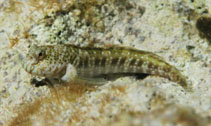
Dorsal spines (total): 13-13; Dorsal soft rays (total): 14-15; Anal spines: 2-2; Anal soft rays: 15-17; Vertebrae: 34-34. Olivaceous with 7 short dark brown double bars on side of body and rows of small pale blue spots (Ref. 13442). |
| Biology: |
Adults occur in intertidal areas (Ref. 31184), like tide pools, rocky slopes, and places where there are boulders on the bottom (Ref. 5521). Actively shuttle back and forth between rock-pools and air (Ref. 31184). They breathe air (Ref. 31184) and can remain out of water for up to 2 hours if kept moist (Ref. 51276). Feed mainly on algae (Ref. 13442). Oviparous. Eggs are demersal and adhesive (Ref. 205), and are attached to the substrate via a filamentous, adhesive pad or pedestal (Ref. 94114). Larvae are planktonic, often found in shallow, coastal waters (Ref. 94114). |
| IUCN Red List Status: |
Least Concern (LC); Date assessed: 08 December 2024 Ref. (130435)
|
| Threat to humans: |
harmless |
Source and more info: www.fishbase.org. For personal, classroom, and other internal use only. Not for publication.