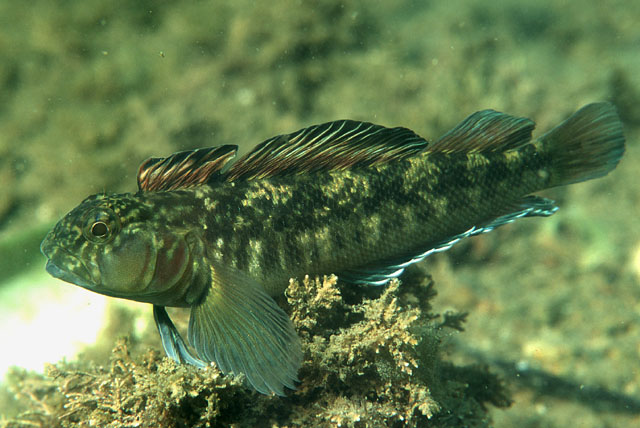
| Tripterygiidae (Triplefin blennies), subfamily: Tripterygiinae |
Deprecated: strlen(): Passing null to parameter #1 ($string) of type string is deprecated in /var/www/html/FieldGuide/FieldGuideSummary.php on line 600
Deprecated: strlen(): Passing null to parameter #1 ($string) of type string is deprecated in /var/www/html/FieldGuide/FieldGuideSummary.php on line 616
9 cm TL (male/unsexed) |
|
demersal; brackish; marine; depth range 0 - 3 m, non-migratory |
| Southwest Pacific: throughout New Zealand. |
|
Dorsal spines (total): 24-27; Dorsal soft rays (total): 11-13; Anal spines: 2-2; Anal soft rays: 24-26; Vertebrae: 42-44. Spines of first dorsal fin high, often as high as second dorsal, with posterior spines longer than anterior. Supraorbital tentacles simple. No sensory papillae on frontal, temporal and upper
part of otic areas. Dorsal fin formula V-0N-0-1-0-1. Ten procurrent rays in upper caudal lobe, 9 in lower lobe; in upper lobe, 1 procurrent ray between upper lobe and posterior epural, 5 opposite epurals, 1 between anterior epural and neural spine of second preural, 2 anterior to neural spine of third preural vertebra; in lower lobe, 8 procurrent rays opposite haemal spine of second preural vertebra, 1 opposite haemal spine of third vertebra. |
| Adults occur in estuaries and lower reaches of rivers and streams (Ref. 13227) where
there is cover from rocks and submerged trees (Ref. 84085). They are also widespread on coastal rocky sea shores, on open coasts, bays, harbours, and inlets (Ref. 13730). Eggs are hemispherical and covered with numerous sticky threads that anchor them in the algae on the nesting sites (Ref. 240). Larvae are planktonic which occur primarily in shallow, nearshore waters (Ref. 94114). |
|
Least Concern (LC); Date assessed: 11 July 2014 Ref. (130435)
|
| harmless |
Source and more info: www.fishbase.org. For personal, classroom, and other internal use only. Not for publication.