
|
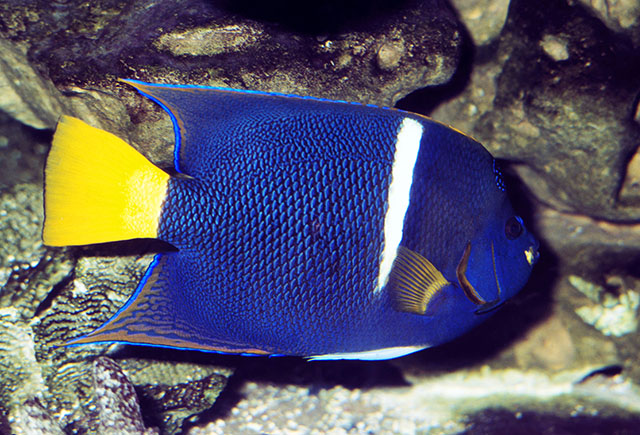
Holacanthus passer Valenciennes, 1846 King angelfish |
|
|
photo by
Muséum-Aquarium de Nancy/D. Terver |
| Family: | Pomacanthidae (Angelfishes) | |||
| Max. size: | 35.6 cm TL (male/unsexed) | |||
| Environment: | reef-associated; marine; depth range 4 - 30 m, non-migratory | |||
| Distribution: | Eastern Pacific: Gulf of California to Peru, including the Galapagos Islands. | |||
| Diagnosis: | ||||
| Biology: | Diurnal grazers on sessile invertebrates and algae but specializes to a larger extent on sponges. They also feed on plankton. Reproduction occurs in late summer. Females are more territorial and form pair bonds with the males. Oviparous (Ref. 240). Monogamous and always in home-ranging pairs, that is they do not defend an exclusive territory (Ref. 52884). Sometimes forms mixed aggregations with Pomacanthus zonipectus (Ref. 9333). Cleaning behavior has been observed in juveniles. | |||
| IUCN Red List Status: | Least Concern (LC); Date assessed: 08 October 2009 Ref. (130435) | |||
| Threat to humans: | harmless | |||