| Carcharhinidae (Requiem sharks) |
Deprecated: strlen(): Passing null to parameter #1 ($string) of type string is deprecated in /var/www/html/FieldGuide/FieldGuideSummary.php on line 600
Deprecated: strlen(): Passing null to parameter #1 ($string) of type string is deprecated in /var/www/html/FieldGuide/FieldGuideSummary.php on line 616
380 cm TL (male/unsexed) |
|
reef-associated; brackish; marine; depth range 0 - 92 m, oceano-estuarine |
| Indo-Pacific: Red Sea and South Africa (including Mauritius, Seychelles, Madagascar) to Philippines, north to Viet Nam, south to Australia. Also from Palau, Marshall Islands, and Tahiti. Recorded from Taiwan (Ref. 4868). |
|
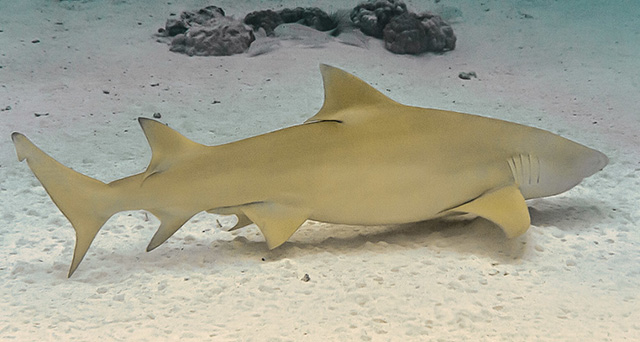
Dorsal spines (total): 0-0; Dorsal soft rays (total): 0-0; Anal spines: 0-0; Anal soft rays: 0-0. A large, stocky, yellowish shark with a broad, blunt snout, narrow, smooth-cusped teeth in both jaws, and equal-sized dorsal fins (Ref. 5578). Yellowish brown above, paler below (Ref. 9997). With two nearly equally large dorsal fins (Ref. 37816). |
| Adults are found on continental and insular shelves and terraces (Ref. 244). And are common on coral reefs (Ref. 5578). Juveniles are confined to shallow inshore areas, with preference for sandy lagoons and turbid, mangrove swamps (Refs. 6871, 129182). Adults feed on smaller sharks, stingrays and on benthic bony fishes (Ref. 5578). Viviparous (Ref. 50449). Dangerous if provoked (Ref. 244). 1 to 11 of 45 cm young are born per litter (Ref. 1602). Meat is utilized fresh and dried salted for human consumption, fins for shark-fin soup base, and liver oil for vitamins (Ref. 244). |
|
Endangered (EN); Date assessed: 16 July 2020 (A2bd) Ref. (130435)
|
| traumatogenic |
Source and more info: www.fishbase.org. For personal, classroom, and other internal use only. Not for publication.