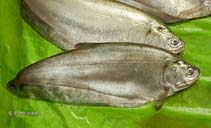
| Family: |
Notopteridae (Featherbacks or knifefishes), subfamily: Notopterinae |
| Max. size: |
Deprecated: strlen(): Passing null to parameter #1 ($string) of type string is deprecated in /var/www/html/FieldGuide/FieldGuideSummary.php on line 600
Deprecated: strlen(): Passing null to parameter #1 ($string) of type string is deprecated in /var/www/html/FieldGuide/FieldGuideSummary.php on line 616
60 cm SL (male/unsexed) |
| Environment: |
demersal; freshwater; brackish; pH range: 6 - 6.5; dH range: 3 - 8, potamodromous |
| Distribution: |
Southeast Asia: Peninsular Malaysia, Thailand (Mekong River), Indonesia (Sumatra and Java) and Myanmar (Lake Inle, Salween basin). |
| Diagnosis: |
Dorsal soft rays (total): 7-9; Anal soft rays: 97-111. Distinguishable by its plain brown adult coloration and the convex or only slightly concave dorsal head profile; juveniles (<5 cm SL) with dark bars on the whole body (Ref. 27732); preopercular scale rows 6-8 (Ref. 7431); silvery-white with numerous fine grey spots on body and head (Ref. 4832). |
| Biology: |
Found in clear streams and enters brackish waters (Ref. 4832). Adults inhabit standing and sluggish waters of lakes, floodplains, canals and ponds (Ref. 12693). Undertake localized lateral migrations from the Mekong River to floodplains during the flood season and back to the mainstream or other permanent water bodies during the dry season (Ref. 37770). Common in tanks throughout the greater parts of India. Feed on insects, fish (Ref. 12693), crustaceans and some young roots of aquatic plants (Ref. 6459). Active during twilight and night. Colonize and breed seasonally during rainy days and migrates back to permanent waters in dry season (Ref. 12693). Breeding takes place in stagnant or running waters in the rainy season. Eggs are laid in small clumps on submerged vegetation. A female measuring 21-25 cm usually lays 1,200-3,000 eggs. The fish is relished both in fresh and dried state. Soup made from it is reported to be given to people with measles (Ref. 7431). Of high economic importance as food fish in South and Southeast Asia to Borneo and Sumatra and taken by all types of small-scale fishing gears (Ref. 57235). |
| IUCN Red List Status: |
Least Concern (LC); Date assessed: 30 August 2019 Ref. (130435)
|
| Threat to humans: |
harmless |
Source and more info: www.fishbase.org. For personal, classroom, and other internal use only. Not for publication.