| Family: |
Blenniidae (Combtooth blennies), subfamily: Blenniinae |
| Max. size: |
Deprecated: strlen(): Passing null to parameter #1 ($string) of type string is deprecated in /var/www/html/FieldGuide/FieldGuideSummary.php on line 600
Deprecated: strlen(): Passing null to parameter #1 ($string) of type string is deprecated in /var/www/html/FieldGuide/FieldGuideSummary.php on line 616
8 cm TL (male/unsexed) |
| Environment: |
reef-associated; marine; depth range 1 - 10 m |
| Distribution: |
Indian Ocean. |
| Diagnosis: |
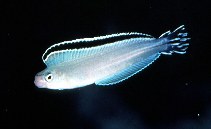
Dorsal spines (total): 7-8; Dorsal soft rays (total): 27-29; Anal spines: 2-2; Anal soft rays: 20-23. Pale grey body, dorsal fin with black submarginal stripe. Pectoral rays typically 12; large curved canine tooth posteriorly on side of lower jaw; interorbital pores 1-2; body depth about 8.0 in SL. Maximum size to 5.1 cm TL (Ref. 90102). |
| Biology: |
Adults are found solitary in coastal, lagoon, and outer reefs, 1-10 m deep (Ref. 90102). Oviparous. Eggs are demersal and adhesive (Ref. 205), and are attached to the substrate via a filamentous, adhesive pad or pedestal (Ref. 94114). Larvae are planktonic, often found in shallow, coastal waters (Ref. 94114). A mimic of Meiacanthus smithi (Ref. 9710). |
| IUCN Red List Status: |
Least Concern (LC); Date assessed: 27 March 2009 Ref. (130435)
|
| Threat to humans: |
harmless |
Source and more info: www.fishbase.org. For personal, classroom, and other internal use only. Not for publication.