>
Eupercaria/misc (Various families in series Eupercaria) >
Gerreidae (Mojarras)
Etymology: Gerres: Latin, gerres = a kind of anchovies; cited by Plinius.
More on author: Cuvier.
Entorno: milieu / zona climática / rango de profundidad / gama de distribución
Ecología
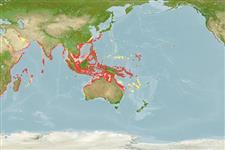
marino; agua dulce; salobre demersal; anfidromo (Ref. 51243); rango de profundidad 1 - 50 m (Ref. 4372). Tropical; 26°C - 29°C (Ref. 4959); 32°N - 35°S, 31°E - 171°E
Indo-West Pacific: East Africa and Madagascar to Japan and Australia; New Caledonia (Ref. 26587) and Vanuatu (Ref. 13300). Enters rivers and lakes in Madagascar and the east coast of Africa. Not in the Middle East (Ref. 103159).
Longitud en la primera madurez / Tamaño / Peso / Edad
Madurez: Lm 19.0 range ? - ? cm
Max length : 39.0 cm TL macho / no sexado; (Ref. 116875); common length : 15.0 cm SL macho / no sexado; (Ref. 4967); edad máxima reportada: 8 años (Ref. 116875)
Espinas dorsales (total) : 9; Radios blandos dorsales (total) : 10 - 11; Espinas anales: 2 - 3; Radios blandos anales: 7 - 8.
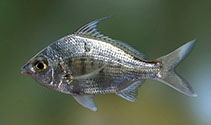
Body shape (shape guide): fusiform / normal; Cross section: compressed.
Adults are coastal inhabitants found on soft bottoms (Ref. 44894), over sandy substrate (Ref. 12693). Juveniles are found in brackish mangrove estuaries, sometimes enter fresh water (Ref. 2847, 44894), lakes (Ref. 4323), tidal creeks (Ref. 44894) and lower freshwater reaches of rivers (Ref. 12915). Feed on small crustaceans, polychaetes and forams on sand or muddy-sand bottoms (Ref. 12915), worms and insect larvae (Ref. 12693). Length at first reproduction was reported to be around 12 cm SL, for a population in a South African estuary (D. Woodland, pers.comm. 07/13). Salted or made into fish sauce.
Juveniles enter estuaries and mangrove areas at 1 cm SL and stay until they reach maturity, at which stage they move out to sea (Ref. 36558).
Woodland, D.J., 1984. Gerreidae. In W. Fischer and G. Bianchi (eds.) FAO species identification sheets for fishery purposes. Western Indian Ocean fishing area 51. Vol. 2. [pag. var.]. FAO, Rome. (Ref. 3409)
Situación en la Lista Roja de la UICN (Ref. 130435: Version 2025-2 (Global))
Amenaza para el ser humano
Harmless
Usos humanos
Pesquerías: escaso valor comercial
Herramientas
Informes especiales
Descargar XML
Fuentes de Internet
Estimaciones basadas en modelos
Temperatura preferida (Referencia
123201): 24.8 - 29.1, mean 28.2 °C (based on 1220 cells).
Índice de diversidad filogenética (Referencia
82804): PD
50 = 0.5000 [Uniqueness, from 0.5 = low to 2.0 = high].
Bayesian length-weight: a=0.01230 (0.01006 - 0.01505), b=3.05 (3.01 - 3.09), in cm total length, based on LWR estimates for this species (Ref.
93245).
Nivel trófico (Referencia
69278): 3.3 ±0.2 se; based on diet studies.
Resiliencia (Referencia
120179): Medio, población duplicada en un tiempo mínimo de 1.4-4.4 años (K=0.3-2.7; tmax=8;).
Vulnerabilidad pesquera (Ref.
59153): Low to moderate vulnerability (32 of 100).
🛈
Nutrientes (Ref.
124155): Calcium = 140 [77, 253] mg/100g; Iron = 1 [1, 2] mg/100g; Protein = 18.7 [16.8, 20.5] %; Omega3 = 0.24 [0.13, 0.42] g/100g; Selenium = 47.4 [26.5, 88.1] μg/100g; VitaminA = 18.7 [5.9, 46.9] μg/100g; Zinc = 1.42 [0.97, 1.98] mg/100g (wet weight);