Elasmobranquios (tiburones y rayas) (sharks and rays) >
Carcharhiniformes (Ground sharks) >
Triakidae (Houndsharks) > Triakinae
Etymology: Mustelus: Latin for weasel, an ancient name for sharks, possibly referring to the pointed snouts, swift movements and/or rapacious feeding behavior of smaller predatory sharks [strictly not tautonymous with Squalus mustelus Linnaeus 1758 since type was designated by the ICZN] (See ETYFish); henlei: In honor of Friedrich Gustav Jacob Henle (1807-1885), German physician, pathologist and anatomist, who, along with Johann Müller, produced the first authoritative work on sharks (1839-1841) (See ETYFish).
Eponymy: Dr Friedrich Gustav Jakob Henle (1809–1885) was a German physician, anatomist and zoologist whose main subjects were ichthyology and human biology. [...] (Ref. 128868), visit book page.
More on author: Gill.
Entorno: milieu / zona climática / rango de profundidad / gama de distribución
Ecología
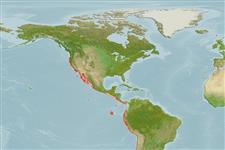
marino demersal; rango de profundidad 0 - 281 m (Ref. 96339). Subtropical; 48°N - 18°S, 126°W - 72°W (Ref. 55310)
Eastern Pacific: northern California, USA to the Gulf of California; Ecuador and Peru.
Longitud en la primera madurez / Tamaño / Peso / Edad
Madurez: Lm 57.0, range 51 - 63 cm
Max length : 100.0 cm TL macho / no sexado; (Ref. 31395); edad máxima reportada: 13 años (Ref. 6098)
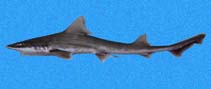
Adults are found on the continental shelves from the intertidal region to at least 200 m depth. They feed on crabs, ghost shrimps, mantis shrimps, isopods, squids, polychaete worms, tunicates and small bony fishes. Viviparous (with a yolk-sac placenta), with 3 to 5 young in a litter. Size at birth between 19 and 21 cm. Readily kept in captivity. Utilized for human consumption. Marketed fresh, smoked and frozen (Ref. 9987).
Viviparous with a yolk-sac placenta; with 3 to 5 young in a litter. Size at birth ranges from 19-21 cm (Ref. 244). Distinct pairing with embrace (Ref. 205). Polyandry is a common life history strategy among the elasmobranchs and for M. henlei, the occurrence and frequency of polyandric behavior may vary depending on location and density of breeding individuals (Ref. 95902).
Compagno, L.J.V., 1984. FAO Species Catalogue. Vol. 4. Sharks of the world. An annotated and illustrated catalogue of shark species known to date. Part 2 - Carcharhiniformes. FAO Fish. Synop. 125(4/2):251-655. Rome: FAO. (Ref. 244)
Situación en la Lista Roja de la UICN (Ref. 130435: Version 2025-2 (Global))
Amenaza para el ser humano
Harmless
Usos humanos
Pesquerías: muy comercial; pesca deportiva: si
Herramientas
Informes especiales
Descargar XML
Fuentes de Internet
Estimaciones basadas en modelos
Temperatura preferida (Referencia
123201): 9.7 - 23.5, mean 15.4 °C (based on 100 cells).
Índice de diversidad filogenética (Referencia
82804): PD
50 = 0.5000 [Uniqueness, from 0.5 = low to 2.0 = high].
Bayesian length-weight: a=0.00229 (0.00107 - 0.00491), b=3.14 (2.97 - 3.31), in cm total length, based on LWR estimates for this Genus-body shape (Ref.
93245).
Nivel trófico (Referencia
69278): 3.6 ±0.4 se; based on diet studies.
Resiliencia (Referencia
120179): Bajo, población duplicada en un tiempo mínimo de 4.5-14 años (rm=0.127; K=0.26; tm=2-6; tmax=15; Fec=3).
Vulnerabilidad pesquera (Ref.
59153): High vulnerability (58 of 100).
🛈
Vulnerabilidad climática (Ref.
125649): High vulnerability (61 of 100).
🛈
Nutrientes (Ref.
124155): Calcium = 20.8 [5.7, 103.5] mg/100g; Iron = 0.509 [0.159, 1.911] mg/100g; Protein = 21.7 [19.4, 24.0] %; Omega3 = 0.147 [0.061, 0.347] g/100g; Selenium = 42.3 [12.2, 148.1] μg/100g; VitaminA = 6.83 [2.38, 18.97] μg/100g; Zinc = 0.616 [0.272, 1.231] mg/100g (wet weight);