Teleostei (teleosts) >
Beloniformes (Needle fishes) >
Exocoetidae (Flyingfishes)
Etymology: Prognichthys: Taken from Progne, name of Philomela´s sister, transformed into a swallow in the Greek mithology + Greek, ichthys = fish (Ref. 45335).
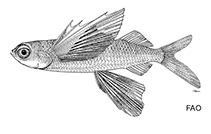
Eponymy: Not a true eponym, Progne (sometimes Procne – see above) was metamorphosed into a swallow. Pliny likened flyingfish to the swallow, and the genus name can be translated as ‘swallow-fish’. Glafira Nikiforovna ‘Tanya’ Pokhil’skaya worked in the Department of Nekton and the Laboratory of Oceanic Ichthyofauna (Russian Academy of Sciences) (1948–1990). Parin has used her ‘high-quality’ (translation) illustrations in many of his papers. (Ref. 128868), visit book page.
Environment: milieu / climate zone / depth range / distribution range
Ecology
Marine; pelagic-oceanic; depth range 0 - ? m. Subtropical
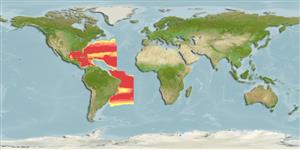
Atlantic Ocean: mostly restricted to cores of central oceanic gyres; in the western Atlantic, it occurs in Bermuda to 20°S but absent from the Gulf of Mexico, east coast of North America, and most of the Caribbean.
Size / Weight / Age
Maturity: Lm ? range ? - ? cm
Max length : 20.1 cm SL male/unsexed; (Ref. 35505)
Mostly restricted to cores of central oceanic gyres (Ref. 35505).
Life cycle and mating behavior
Maturity | Reproduction | Spawning | Eggs | Fecundity | Larvae
Smith-Vaniz, W.F., B.B. Collette and B.E. Luckhurst, 1999. Fishes of Bermuda: history, zoogeography, annotated checklist, and identification keys. American Society of Ichthyologists and Herpetologists Special Publication No. 4. 424 p. (Ref. 35505)
IUCN Red List Status (Ref. 130435: Version 2025-2 (Global))
Threat to humans
Harmless
Human uses
Tools
Fatal error: Uncaught mysqli_sql_exception: Too many connections in /var/www/html/includes/speciessummary.lib.php:1888
Stack trace:
#0 /var/www/html/includes/speciessummary.lib.php(1888): mysqli->__construct('mysql', 'fbuser', Object(SensitiveParameterValue), 'fbquizv2', '3306')
#1 /var/www/html/summary/SpeciesSummary.php(1851): checkRecordDisplayFBQuizV2('60690', 'PicList')
#2 {main}
thrown in /var/www/html/includes/speciessummary.lib.php on line 1888