>
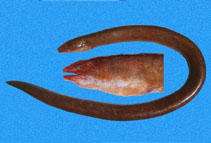
Anguilliformes (Eels and morays) >
Heterenchelyidae (Mud eels)
Etymology: Pythonichthys: Greek, python = the huge serpent or monster slain near Delphi by Apollo in the Greek mithology (1590) Greek, ichthys = fish (Ref. 45335).
More on authors: Rosenblatt & Rubinoff.
Ambiente: milieu / zona climatica / distribuzione batimetrica / gamma di distribuzione
Ecologia
marino demersale; distribuzione batimetrica ? - 17 m (Ref. 40789). Tropical
Eastern Central Pacific: Mexico and Panama.
Dimensione / Peso / Età
Maturità: Lm ? range ? - ? cm
Max length : 47.2 cm TL maschio/sesso non determinato; (Ref. 40789)
Breve descrizione
Chiavi di identificazione | Morfologia | Morfometria
Ciclo vitale e comportamento di accoppiamento
Maturità | Riproduzione | Deposizione | Uova | Fecondità | Larve
Smith, D.G., 1994. Catalog of type specimens of recent fishes in the National Museum of Natural History, Smithsonian Institution, 6: Anguilliformes, Saccopharyngiformes, and Notacanthiformes (Teleostei: Elopomorpha). Smithson. Contrib. 566:50 p. (Ref. 40789)
Stato della Lista Rossa IUCN (Ref. 130435: Version 2025-2 (Global))
Minaccia per l'uomo
Harmless
Usi umani
Strumenti
Rapporti speciali
Scarica XML
Fonti Internet
Stime basate su modelli
Indice di diversità filogenetica (Fonte Biblio.
82804): PD
50 = 0.5664 [Uniqueness, from 0.5 = low to 2.0 = high].
Bayesian length-weight: a=0.00102 (0.00046 - 0.00225), b=3.06 (2.88 - 3.24), in cm total length, based on all LWR estimates for this body shape (Ref.
93245).
Livello trofico (Fonte Biblio.
69278): 3.7 ±0.6 se; based on size and trophs of closest relatives
Vulnerabilità della pesca (Ref.
59153): Moderate vulnerability (37 of 100).
🛈