Ελασμοβράγχιοι (καρχαρίες και σαλάχια) (sharks and rays) >
Carcharhiniformes (Ground sharks) >
Pentanchidae (Deepwater catsharks)
Etymology: Haploblepharus: haplos (Gr.), single or simple; blepharon (Gr.), eyelid, referring to simple structure of lower eyelid, which closes against upper eyelid to protect the eye (See ETYFish); fuscus: Latin for dusky, dark or swarthy, probably referring to its overall drab-brown coloration (See ETYFish).
More on author: Smith.
Περιβάλλον: περιβάλλον / κλιματική ζώνη / εύρος βάθους / εύρος διανομής
Οικολογία
Θαλασσινό(ά) Υφαλόφιλο(α). Subtropical; 30°S - 35°S
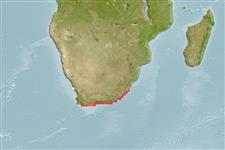
Southeast Atlantic: just west of Cape Agulhas to southern Natal in South Africa (Ref. 5578). This species is sympatric with Haploblepharus edwardsii in the southeastern Cape region but there is at least partial microhabitat separation between the two - Haploblepharus fuscus occurs inshore while Haploblepharus edwardsii occurs in deeper water offshore (Ref. 244).
Μέγεθος / Βάρος / Ηλικία
Γεννητική Ωρίμανση: Lm ? range ? - ? cm
Max length : 69.0 cm TL αρσενικό/απροσδιόριστο; (Ref. 244); 73.0 cm TL (female)
Σύντομη περιγραφή
Κλείδες προσδιορισμού | Μορφολογία | Μορφομετρία
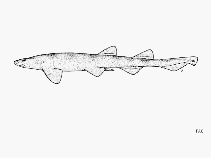
Ραχιαίες άκανθες (συνολικά) : 0; Εδρικές άκανθες: 0. The largest shyshark, usually plain yellowish-brown above becoming just yellowish below; small light spots and indistinct brown saddles in some specimens (Ref. 5578).
Body shape (shape guide): elongated.
Found close inshore on the continental shelf, often in shallow, rocky areas (Ref. 244). Feeds on lobsters, crabs and small bony fish (Ref. 5578). Oviparous (Ref. 50449). Readily kept in captivity (Ref. 244). Caught by shore anglers (Ref. 5578).
Κύκλος ζωής και συμπεριφορά ζευγαρώματος
Γεννητική Ωρίμανση | Αναπαραγωγή | Γεννοβολία | Αβγά | Γονιμότητα | Προνύμφες
Oviparous, laying 2 egg cases at a time (Ref. 11228). Embryos feed solely on yolk (Ref. 50449).
Compagno, L.J.V., 1984. FAO Species Catalogue. Vol. 4. Sharks of the world. An annotated and illustrated catalogue of shark species known to date. Part 2 - Carcharhiniformes. FAO Fish. Synop. 125(4/2):251-655. Rome: FAO. (Ref. 244)
Κατάσταση Κόκκινου Καταλόγου IUCN (Ref. 130435: Version 2025-2 (Global))
Απειλή για τον άνθρωπο
Harmless
Ανθρώπινες χρήσεις
αλιεία: παραδοσιακή αλιεία; αλιεία αναψυχής: ναί
Εργαλεία
Ειδικές εκθέσεις
Λήψη XML
Διαδικτυακές πηγές
Εκτιμήσεις βάσει μοντέλων
Προτιμώμενη θερμοκρασία (Αναφ.
123201): 17.1 - 23.4, mean 20.8 °C (based on 49 cells).
Δείκτης φυλογενετικής ποικιλότητας (Αναφ.
82804): PD
50 = 0.5625 [Uniqueness, from 0.5 = low to 2.0 = high].
Bayesian length-weight: a=0.00347 (0.00172 - 0.00698), b=3.08 (2.90 - 3.26), in cm total length, based on LWR estimates for this (Sub)family-body shape (Ref.
93245).
Τροφικό Επίπεδο (Αναφ.
69278): 4.0 ±0.63 se; based on food items.
Ελαστικότητα (Αναφ.
120179): Χαμηλό, ελάχιστος χρόνος για διπλασιασμό πληθυσμού 4,5 - 14 έτη (Fec assumed to be <100).
Ευπάθεια στην αλιεία (Ref.
59153): Moderate to high vulnerability (49 of 100).
🛈
Θρεπτικά συστατικά (Ref.
124155): Calcium = 8.34 [1.79, 45.04] mg/100g; Iron = 0.369 [0.095, 1.072] mg/100g; Protein = 19.2 [16.1, 22.2] %; Omega3 = 0.121 [0.049, 0.280] g/100g; Selenium = 13.1 [3.8, 40.2] μg/100g; VitaminA = 40.7 [13.6, 130.3] μg/100g; Zinc = 0.589 [0.272, 1.236] mg/100g (wet weight);