>
Eupercaria/misc (Various families in series Eupercaria) >
Sparidae (Porgies)
Etymology: Acanthopagrus: Greek, akantha = thorn + Greek, pagros, a kind of fish (Ref. 45335).
More on author: Günther.
Ambiente: milieu / zona climática / intervalo de profundidade / gama de distribuição
Ecologia
marinhas; estuarina demersal; oceanódromo. Temperate; 19°S - 38°S
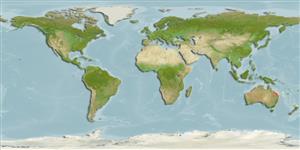
Southwest Pacific: endemic to eastern Australia, from Townsville in Queensland to the Gippsland Lakes in Victoria (Ref. 75154). Occurrence in Japan and Ryukyu Islands (Ref. 559) and Taiwan (Ref. 5193) need verification.
Comprimento na primeira maturidade / Tamanho / Peso / Idade
Maturidade: Lm ?, range 24 - ? cm
Max length : 66.0 cm SL macho/indeterminado; (Ref. 44894); peso máx. Publicado: 4.5 kg (Ref. 6390); Idade máx. registada: 14 anos (Ref. 56606)
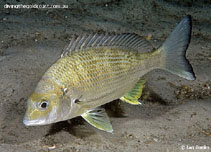
Inhabitant estuaries, coastal rivers, creeks, lakes and bays, usually in marine or brackish water, but in dry seasons they penetrate the lowermost reaches of fresh water (Ref. 44894). Common in coastal and estuarine rocky habitat. They enter rivers upstream to the limit of brackish waters. They migrate from their feeding to their spawning grounds; they spawn mainly during winter in the vicinity of river entrances; eggs are planktonic and hatch after 2.5 days. A portion of the population changes sex from male to female after spawning. They feed on mollusks, crustaceans, worms, fish and ascidians. It is parasitised by the monogeneans Anoplodiscus australis and A. spari on the fins and body surface (Ref. 124057).
A proportion of the population change sex from male to female after their first spawning season (Ref. 6390). Other fish remain functional males throughout their life and another small proportion develop directly into females at the age of 4 years (Ref. 27246, 28262). Also Ref. 28504.
The eggs and larvae are planktonic (Ref. 30572). After about four weeks the developed fry enter the estuary at night on the full moon and settle in estuarine littoral areas at about 1.4 cm in length (Ref. 30572). The fry rapidly develop into juveniles and grow to about 10 cm after one year (Ref. 30572).
Kailola, P.J., M.J. Williams, P.C. Stewart, R.E. Reichelt, A. McNee and C. Grieve, 1993. Australian fisheries resources. Bureau of Resource Sciences, Canberra, Australia. 422 p. (Ref. 6390)
Categoria na Lista Vermelha da IUCN (Ref. 130435: Version 2025-2 (Global))
Ameaça para o homem
Harmless
Utilização humana
Pescarias: espécies comerciais; Aquacultura: espécies comerciais; peixe desportivo: sim
Ferramentas
Relatórios especiais
Descarregue XML
Fontes da internet
Estimativas baseadas em modelos
Temperatura preferida (Ref.
123201): 20.2 - 26.1, mean 24.7 °C (based on 68 cells).
Índice de diversidade filogenética (Ref.
82804): PD
50 = 0.5000 [Uniqueness, from 0.5 = low to 2.0 = high].
Bayesian length-weight: a=0.01259 (0.00603 - 0.02627), b=3.03 (2.86 - 3.20), in cm total length, based on LWR estimates for this (Sub)family-body shape (Ref.
93245).
Nível Trófico (Ref.
69278): 3.1 ±0.40 se; based on food items.
Resiliência (Ref.
120179): Baixo, tempo mínimo de duplicação da população 4,5 - 14 anos (tm=3-4; tmax=14; Fec=300,000).
Vulnerabilidade da pesca (Ref.
59153): Moderate to high vulnerability (52 of 100).
🛈
Nutrientes (Ref.
124155): Calcium = 35.9 [17.6, 68.9] mg/100g; Iron = 0.358 [0.201, 0.691] mg/100g; Protein = 19.4 [18.3, 20.5] %; Omega3 = 0.57 [0.34, 0.97] g/100g; Selenium = 10.5 [5.1, 20.6] μg/100g; VitaminA = 10.2 [3.0, 30.3] μg/100g; Zinc = 0.67 [0.47, 0.95] mg/100g (wet weight);