>
Cypriniformes (Carps) >
Danionidae (Danios) > Rasborinae
Etymology: Boraras: A name for a fish used in Borneo = "boraras merah"; naevus: From the Latin naevus, a spot, a mark on skin, a blemish, in allusion to the large sexually dichromatic blotch on the side of the body. A noun in apposition (Ref. 87760).
More on authors: Conway & Kottelat.
Meio ambiente: milieu / Zona climática / intervalo de profundidade / faixa de distribuição
Ecologia
; Água doce pelágico(a,os,as). Tropical
Asia: Thailand. Type locality, in a swampy area north of Surat Thani. The species is reported to have a wider distribution in the lower Tapi drainage, on the Gulf of Thailand slope of peninsular Thailand. It is suspected that most of its natural habitats (swamps) has been transformed into paddy fields. Additional populations, or another, similar species is known from the Andaman Sea slope of the Malay Peninsula near Trang (Ref. 87760).
Tamanho / Peso / Idade
Maturidade: Lm ? range ? - ? cm
Max length : 1.3 cm SL macho/indeterminado; (Ref. 87760)
Descrição suscinta
Chaves de identificação | Morfologia | Morfometria
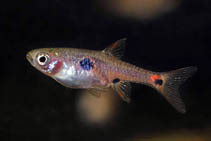
Boraras naevus is distinguished from its congeners with a similar blotched color pattern (viz. B. maculatus and B. micros) by pronounced sexual dimorphism of the anteriormost blotch situated on the body side, which is a small circular marking of roughly orbit size or smaller in females and a large dorso-ventrally orientated oval-shaped marking larger than the orbit in males (vs. anteriormost blotch similar in size and shape in both sexes) and by its lower number of principal caudal-fin rays (9+8 vs. 9+9 in B. micros, 9–10+9 in B. maculatus). It is further distinguished from B. maculatus by its lower number of body scales in the midlateral row (24–26 vs. 26–29), and its lower number of pelvic-fin rays (i.5.i vs. i.6.i), and from B. micros by its higher number of body scales in the midlateral row (24–26 vs. 22–23), higher number of branched dorsal-fin rays (7 vs. 5–6), the presence of red and black pigment along the anterior edge of the dorsal and anal fins of males in life (vs. all fins transparent without red or black pigmentation in life in both sexes), the presence of infraorbital 4 (vs. infraorbital 4 absent), infraorbital 2 contacting both infraorbital 1 and infraorbital 3 (vs. infraorbital 2 greatly reduced in size, without contact with adjacent infraorbital bones), and the presence of the mesocoracoid (vs. mesocoracoid absent). Boraras naevus can be distinguished from the remaining species of Boraras (B. brigittae, B. merah and B. urophthalmoides) by the absence of a midlateral stripe (vs. broad, uninterrupted midlateral stripe from upper extremity of gill opening to middle of caudal-fin base in B. brigittae and B. urophthalmoides; or narrow, frequently interrupted midlateral stripe from above anal-fin origin to middle of caudal-fin base in B. merah) (Ref. 87760).
Ciclo de vida ou comportamento de acasalamento
Maturidade | Reprodução | Desova | Ovos | Fecundidade | Larvas
Conway, K.W. and M. Kottelat, 2011. Boraras naevus, a new species of miniature and sexually dichromatic freshwater fish from peninsular Thailand (Ostariophysi: Cyprinidae). Zootaxa 3002:45-51. (Ref. 87760)
Status na Lista Vermelha da UICN (Ref. 130435: Version 2025-2 (Global))
Ameaça para os humanos
Harmless
Uso pelos humanos
Ferramentas
Relatórios especiais
Baixar XML
Fontes da internet
Estimativas baseadas em modelos
Índice de diversidade filogenética (Ref.
82804): PD
50 = 0.5156 [Uniqueness, from 0.5 = low to 2.0 = high].
Bayesian length-weight: a=0.00891 (0.00382 - 0.02082), b=3.02 (2.82 - 3.22), in cm total length, based on LWR estimates for this (Sub)family-body shape (Ref.
93245).
Nível Trófico (Ref.
69278): 2.8 ±0.4 se; based on size and trophs of closest relatives
Vulnerabilidade da pesca (Ref.
59153): Low vulnerability (10 of 100).
🛈