Classificação / Nomes
Nomes comuns | Sinónimos | Catalog of Fishes(Género, Espécies) | ITIS | CoL | WoRMS | Cloffa
>
Gymnotiformes (Knifefishes) >
Hypopomidae (Bluntnose knifefishes)
Etymology: Brachyhypopomus: Greek, brachys, eia = short + Greek, hypo = under + Greek, poma, -atos = cover (Ref. 45335); walteri: Named for Walter Heiligenberg in honor of his discoveries in electric fish neurophysiology and behavior made at the Scripps Institute of Oceanography.
Institute of Oceanography.
Eponymy: Dr Walter F Heiligenberg (1938–1994) was an ethologist who was (1976–1994) Professor of Behavioural Physiology, Scripps Institute of Oceanography, University of California, San Diego, having joined earlier (1973). [...] (Ref. 128868), visit book page.
Ambiente: milieu / zona climática / intervalo de profundidade / gama de distribuição
Ecologia
; Água doce bentopelágico. Tropical
South America: Amazon basin.
Tamanho / Peso / Idade
Maturidade: Lm ? range ? - ? cm
Max length : 17.5 cm TL macho/indeterminado; (Ref. 94132)
Descrição breve
Chaves de identificação | Morfologia | Morfometria
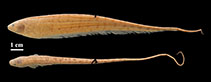
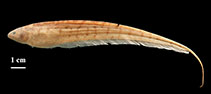
This species can be distinguished by having the following combination of characters: distinct patch of brown pigment below skin at base of orbit; body yellow and semi-translucent in living specimens; caudal filament long and fine, greater than 20% of LEA (length from the tip of the
snout to the posterior end of the anal-fin base) in intact specimens; electric discharge organ (EOD ) pulse duration very long (between 3.5 and 4 milliseconds at 25° C) with head-positive first phase of longer duration than second head-negative phase in both sexes (Ref. 94132).
Body shape (shape guide): elongated.
Facultative air-breathing in the genus (Ref. 126274); Usually found in floating meadow habitats, composed mostly of the grass Paspalum repens, Poaceae. Occurs mainly in white water, but also in areas near the confluence of black water rivers with the Amazonas/Solimões ranging from low to medium conductivity. Syntopic with the species of Eigenmannia, Gymnotus, the apteronotid Parapteronotus hasemani and the electric eel Electrophorus electricus in the floating meadow habitats (Ref. 94132).
Ciclo de vida e comportamento de acasalamento
Maturidade | Reprodução | Desova | Ovos | Fecundidade | Larvas
Sullivan, J.P., J. Zuanon and C. Cox Fernandes, 2013. Two new species and new subgenus of toothed Brachyhypopomus electric knifefishes (Gymnotiformes, Hypopomidae) from the central Amazon and considerations pertaining to the evolution of a monophasic electric organ discharge. Zookeys 327:1-34. (Ref. 94132)
Categoria na Lista Vermelha da IUCN (Ref. 130435: Version 2025-2 (Global))
Ameaça para o homem
Harmless
Utilização humana
Ferramentas
Relatórios especiais
Descarregue XML
Fontes da internet
Estimativas baseadas em modelos
Índice de diversidade filogenética (Ref.
82804): PD
50 = 0.5000 [Uniqueness, from 0.5 = low to 2.0 = high].
Bayesian length-weight: a=0.00372 (0.00141 - 0.00980), b=3.06 (2.83 - 3.29), in cm total length, based on LWR estimates for this (Sub)family-body shape (Ref.
93245).
Nível Trófico (Ref.
69278): 3.1 ±0.4 se; based on size and trophs of closest relatives
Vulnerabilidade da pesca (Ref.
59153): Low vulnerability (10 of 100).
🛈