Ελασμοβράγχιοι (καρχαρίες και σαλάχια) (sharks and rays) >
Carcharhiniformes (Ground sharks) >
Carcharhinidae (Requiem sharks)
Etymology: Carcharhinus: karcharos (Gr.), sharp or jagged; rhinus, an ancient name for sharks, from rhine (Gr.), rasp, both words alluding to a shark's jagged, rasp-like skin (See ETYFish); tilstoni: In honor of Richard Tilston, naturalist-surgeon at Port Essignton, Northern Territory, near where holotype was collected in the 1840s (See ETYFish).
Eponymy: Richard Tilston was a naturalist who trained as a physician at Guy’s Hospital, London (1841) and became a naval surgeon (1842). [...] (Ref. 128868), visit book page.
More on author: Whitley.
Περιβάλλον: περιβάλλον / κλιματική ζώνη / εύρος βάθους / εύρος διανομής
Οικολογία
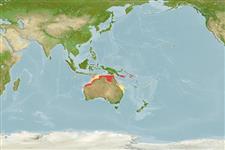
Θαλασσινό(ά); Υφάλμυρο pelagic-neritic; εύρος βάθους 0 - 150 m (Ref. 6871). Tropical; 10°S - 28°S
Indo-West Pacific: currently known only from the continental shelf of tropical Australia. Very similar to Carcharhinus limbatus and reliably distinguished only by biochemical studies and vertebral counts (Ref. 9819).
Μήκος κατά την πρώτη ωρίμανση / Μέγεθος / Βάρος / Ηλικία
Γεννητική Ωρίμανση: Lm ?, range 115 - ? cm
Max length : 200 cm TL αρσενικό/απροσδιόριστο; (Ref. 9997); μεγ. δημοσιευμένο βάρος: 52.0 kg (Ref. 6390); μεγ. αναφερόμενη ηλικία: 12 έτη (Ref. 6390)
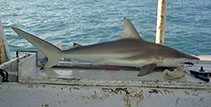
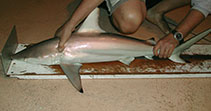
Ραχιαίες άκανθες (συνολικά) : 0; Εδρικές άκανθες: 0. Back dark grey, ashy blue or dusky bronze; belly white or yellowish white; a dark band extending rearward along each side to about over origin of pelvic fin; tips of pelvic fins with a persistent black spot (Ref. 9997).
Body shape (shape guide): fusiform / normal.
Found on the continental shelf from close inshore to about 150 m depth (Ref. 9997). Found throughout the water column but usually near the sea bed during the day and near the surface at night (Ref. 6390). Prefers teleost fishes but also feeds on cephalopods to a lesser degree. Viviparous (Ref. 50449). Forms large aggregations (Ref. 6871). Utilized for its meat and fins (Ref. 6871). The flesh has a relatively high mercury content (Ref. 6871).
Viviparous, placental (Ref. 50449). The average litter size is 3, with a range of 1-6, average total length at birth is 60 cm. Pups are born in January after a 10-month gestation period. These sharks breed once each year (Ref. 13440). Distinct pairing with embrace (Ref. 205).
Kailola, P.J., M.J. Williams, P.C. Stewart, R.E. Reichelt, A. McNee and C. Grieve, 1993. Australian fisheries resources. Bureau of Resource Sciences, Canberra, Australia. 422 p. (Ref. 6390)
Κατάσταση Κόκκινου Καταλόγου IUCN (Ref. 130435: Version 2025-2 (Global))
Απειλή για τον άνθρωπο
Harmless
Ανθρώπινες χρήσεις
αλιεία: περιορισμένης εμπορικότητας
Εργαλεία
Ειδικές εκθέσεις
Λήψη XML
Διαδικτυακές πηγές
Εκτιμήσεις βάσει μοντέλων
Προτιμώμενη θερμοκρασία (Αναφ.
123201): 26 - 28.7, mean 27.7 °C (based on 424 cells).
Δείκτης φυλογενετικής ποικιλότητας (Αναφ.
82804): PD
50 = 0.5000 [Uniqueness, from 0.5 = low to 2.0 = high].
Bayesian length-weight: a=0.00525 (0.00244 - 0.01130), b=3.07 (2.90 - 3.24), in cm total length, based on LWR estimates for this Genus-body shape (Ref.
93245).
Τροφικό Επίπεδο (Αναφ.
69278): 4.2 ±0.6 se; based on diet studies.
Generation time: 7.8 ( na - na) years. Estimated as median ln(3)/K based on 2
growth studies.
Ελαστικότητα (Αναφ.
120179): Χαμηλό, ελάχιστος χρόνος για διπλασιασμό πληθυσμού 4,5 - 14 έτη (K=0.14; tm=3-4; tmax=12).
Ευπάθεια στην αλιεία (Ref.
59153): High to very high vulnerability (70 of 100).
🛈