>
Gobiiformes (Gobies) >
Gobiidae (Gobies) > Gobiinae
Etymology: Cryptocentrus: Greek, kryptos = hidden + Greek, kentron = sting (Ref. 45335); cyanospilotus: Name from Greek word meaning blue-spotted; referring to the diagnostic feature colour pattern. The scientific name also refers to the previously published common name for this species, Bluespot Shrimpgoby.
Lingkungan: lingkungan / zona iklim / kisaran kedalaman / jangkauan distribusi
Ekologi
laut berasosiasi dengan karang; kisaran kedalaman 2 - 18 m (Ref. 92356). Tropical
Western Pacific: Caroline Islands, Solomon Islands, Papua New Guinea, Indonesia, Malaysia, Philippines and Ryukyu Is.
Ukuran / Berat / umur
Kematangan: Lm ? range ? - ? cm
Max length : 4.1 cm SL jantan/; (Ref. 92356); 4.1 cm SL (female)
deskripsi pendek
Kunci identifiaksi (pengenalan) | Morfologi | Morfometrik
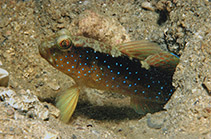
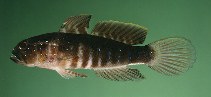
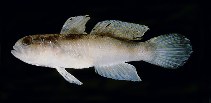
Duri punggung (Keseluruhan (total)) : 6 - 7; duri punggung lunak (Keseluruhan (total)) : 10; Duri dubur: 1; Sirip dubur lunak: 9. Characterized by the following: dorsal rays VI-I,10; anal rays I,9; pectoral rays usually 16; scales in longitudinal series 49-54; predorsal scales 10-13; scales ctenoid posteriorly on upper two-thirds of side anterior to level of about fifth or sixth soft dorsal ray; cycloid on lower side, including abdomen, prepelvic region, and pectoralfin base; head naked except side of nape and predorsal region, scales extending anteriorly to level of rear margin of preopercle; body depth at pelvic-fin origin 3.8-4.3 in SL; gill opening extending forward nearly to a vertical at posterior edge of preopercle; dorsal spines progressively longer to fourth, longest 1.1-1.4 in HL; rounded caudal fin, longer than head, 2.7-3.2 in SL; pectoral fins reaching to level of second dorsal-fin origin, 3.4-4.0 in SL; pelvic fins reaching posteriorly to about anus, 3.7-4.1 in SL; colour variable, generally pale to dark brown; male with about eight narrow pale bars on body and oblique brown bandson basal portion of dorsal fins; both sexes with small blue spots scattered on cheek and operculum, and similar spots on body more or less arranged in vertical rows with 2-4 spots per row; female often whitish or pale grey dorsally on head, sometimes with several dark brown and pale grey saddles along back, and elliptical orange spots on second dorsal fin; pelvic fins of both sexes frequently pale yellowish, sometimes white (Ref. 92356).
A relatively common species, observed in many occasions, and it occurs singly or in pairs. It is invariably associated with unidentified snapping shrimps of the genus Alpheus that share the same burrows, consisting of silty-sand bottoms in sheltered waters (Ref. 92356).
Siklus hidup dan perilaku kawin
Kematangan | Reproduksi, perkembang biakan | Pemijahan | telur-telur | Fekunditas | Larva
Allen, G.R. and J.E. Randall, 2011. Two new species of shrimp-associated gobies (Gobiidae: Cryptocentrus) from the Western Pacific. Marine Biology Research 7(6):554-564. (Ref. 92356)
Status IUCN Red List (Ref. 130435: Version 2025-2 (Global))
ancaman kepada manusia
Harmless
penggunaan manusia
Alat, peralatan
laporan khas
muat turun XML
Sumber internet
Estimasi berdasarkan model
Indeks keanekaragaman filogenetik (Acuan
82804): PD
50 = 0.5000 [Uniqueness, from 0.5 = low to 2.0 = high].
Bayesian length-weight: a=0.00741 (0.00347 - 0.01582), b=3.09 (2.91 - 3.27), in cm total length, based on LWR estimates for this (Sub)family-body shape (Ref.
93245).
Tingkat Trofik (Acuan
69278): 3.2 ±0.3 se; based on size and trophs of closest relatives
Daya lenting (Acuan
120179): Tinggi, Waktu penggandaan populasi minimum kurang dari 15 bulan (Preliminary K or Fecundity.).
Kerentanan Penangkapan Ikan (Ref.
59153): Low vulnerability (10 of 100).
🛈