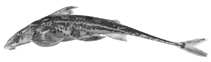
Klassifizierung / Names
Namen | Synonyme | Catalog of Fishes(Gattung, Arten) | ITIS | CoL | WoRMS | Cloffa
>
Siluriformes (Catfishes) >
Amphiliidae (Loach catfishes) > Doumeinae
Etymology: Doumea: Taken form a locality, Doumé, in Congo (Ref. 45335); stilicauda: The species name, stilicauda, from the Latin stilus, a stake, and cauda, tail, refers to the stake-like caudal peduncle; treated as a noun (Ref. 85844).
More on authors: Ferraris, Skelton & Vari.
Umwelt: Milieu / Klimazone / Tiefenbereich / Verbreitungsgebiet
Ökologie
; süßwasser demersal. Tropical
Africa: only known from the So'o River, a tributary of the Nyong River, in Cameroon (Ref. 85844).
Größe / Gewicht / Alter
Geschlechtsreife: Lm ? range ? - ? cm
Max length : 17.5 cm SL Männchen/unbestimmt; (Ref. 85844)
Kurzbeschreibung
Bestimmungsschlüssel | Morphologie | Morphometrie
Rückenflossenstacheln (insgesamt) : 0; Rückenflossenweichstrahlen (insgesamt) : 7; Afterflossenstacheln: 0; Afterflossenweichstrahlen: 8 - 10. Diagnosis: Doumea stilicauda is distinguished from all its congeners, except D. chappuisi and D. reidi, by having the dorsolateral and ventrolateral vertebral processes extending through the dermis to form longitudinal bony ridges from slightly anterior to the base of the adipose fin posteriorly to the caudal-fin base and from somewhat anterior of the anal-fin origin to the caudal-fin base; the exposed processes are in shape of longitudinal bars with slightly corrugated surfaces that together form irregular longitudinal ridges (Ref. 85844). Doumea stilicauda differs from D. chappuisi in predorsal length 27-30% of standard length, vs. 32-37%; head length 15-17% of standard length, vs. 19-23%; caudal-peduncle length 35-41% of standard length, vs. 22-29%; and caudal-peduncle depth 19.6-25.8 times in caudal-peduncle length, vs. 7.3-14.5 times (Ref. 85844). Doumea stilicauda differs from D. reidi in predorsal length 27-30% of standard length, vs. 33%; head length 15-17% of standard length, vs. 18%; caudal-peduncle length 35-41% of standard length, vs. 22-29%); and caudal-peduncle depth 19.6-25.8 times in caudal-peduncle length, vs. 11.8 times (Ref. 85844).
Body shape (shape guide): elongated.
It is found in a 'blackwater' rainforest system with low pH waters, its mean pH 6.2 (Ref. 85844).
Lebenszyklus und Paarungsverhalten
Geschlechtsreife | Fortpflanzung | Ablaichen | Eier | Fruchtbarkeit | Larven
Ferraris, C.J., P. Skelton and R.P. Vari, 2010. Species of the Doumea chappuisi complex (Siluriformes, Amphiliidae) with the descriptions of new species from the upper Sanaga River and Nyong River basins. Copeia 2010(4):705-715. (Ref. 85844)
IUCN Rote Liste Status (Ref. 130435: Version 2025-2 (Global))
Bedrohung für Menschen
Harmless
Nutzung durch Menschen
Tools
Zusatzinformationen
Download XML
Internet Quellen
Schätzungen auf der Grundlage von Modellen
Phylogenetischer Diversitätsindex (Ref.
82804): PD
50 = 0.5020 [Uniqueness, from 0.5 = low to 2.0 = high].
Bayesian length-weight: a=0.00389 (0.00180 - 0.00842), b=3.12 (2.94 - 3.30), in cm total length, based on all LWR estimates for this body shape (Ref.
93245).
Trophische Ebene (Ref.
69278): 3.1 ±0.4 se; based on size and trophs of closest relatives
Widerstandsfähigkeit (Ref.
120179): mittel, Verdopplung der Population dauert 1,4 - 4,4 Jahre. (Preliminary K or Fecundity.).
Anfälligkeit der Fischerei (Ref.
59153): Low vulnerability (11 of 100).
🛈