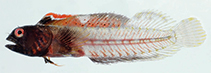
>
Blenniiformes (Blennies) >
Chaenopsidae (Pike-, tube- and flagblennies)
Etymology: Emblemariopsis: Latin, emblema = insertion, inlaid work, raised ornament + Greek, opsis = appearance (Ref. 45335); falcon: Named for the Venezuelan state of Falcon, the location at which the species was first recognized by Jose Gregorio Rodríguez in 2008.
Ambiente: milieu / zona climatica / distribuzione batimetrica / gamma di distribuzione
Ecologia
marino benthopelagico; distribuzione batimetrica 10 - 12 m (Ref. 125603). Tropical
Western Atlantic: Venezuela.
Dimensione / Peso / Età
Maturità: Lm ? range ? - ? cm
Max length : 2.5 cm SL maschio/sesso non determinato; (Ref. 125603)
Breve descrizione
Chiavi di identificazione | Morfologia | Morfometria
Spine dorsali (totale) : 20 - 21; Raggi dorsali molli (totale) : 11 - 12; Spine anali: 2; Raggi anali molli: 20 - 21. This species is distinguished by the following characters: with an orbital cirrus and a red banner (a set of 7 spp.); TP territorial males live in holes, with a black head and blackened anterior dorsal fin with a distal red band over a narrow white band and a thin white margin, the red band extending posteriorly to 5th-7th spinous membrane, curved down at front when erected in displaying TP, the narrow anterior flap variably present along first spine; with first 10 dorsal-fin spines relatively short and about equal length, the first spine reaching to 5th-6th spine base when adpressed, about half of HL, 11-12% SL; profile of anterior dorsal fin usually a straight line or slight concavity.
Colouration: TP dark-shaded and pale with a red-banded dorsal fin with irregular rows of larger dark spots along membranes of mid and posterior spinous-dorsal fin; the lower operculum and branchiostegal membranes with prominent narrow white lines alternating with wider rust-red or dark bands (= banded-operculum group of 3 spp.); row of discrete small dark spots along anterior lateral midline absent, uncommon with a row of dark spots along anterior upper body; transitional males have variably elongated anterior dorsal-fin spines with a distal red band over reticulated brown to orange bands on first three membranes.
IP with elongated first two dorsal-fin spines, often orange-tipped membranes, the first spine reaching to the base of 6th-9th spine base when adpressed, the second slightly shorter, third about 1/2 of first (earlier IP and juvenile with less elongate spines). Colouration: live colors include red, orange, and pink; cranial pattern not documented; IP head spots usually full complement; melanophores near pectoral-fin base typically form a long, thin, slightly oblique bar, usually followed by one or more spots (Ref. 125603).
Cross section: oval.
Found in areas with dead colonies of Colpophyllia brain corals, and less than one meter deep at Los Roques. Occur in groups (Ref. 125603).
Ciclo vitale e comportamento di accoppiamento
Maturità | Riproduzione | Deposizione | Uova | Fecondità | Larve
Victor, B.C., 2020. Review of the glass blennies (Teleostei: Chaenopsidae: Emblemariopsis) with two new species from the Caribbean Sea. J. Ocean Sci. Found. 37:1-122. (Ref. 125603)
Stato della Lista Rossa IUCN (Ref. 130435: Version 2025-2 (Global))
Minaccia per l'uomo
Harmless
Usi umani
Strumenti
Rapporti speciali
Scarica XML
Fonti Internet
Stime basate su modelli
Indice di diversità filogenetica (Fonte Biblio.
82804): PD
50 = 0.5001 [Uniqueness, from 0.5 = low to 2.0 = high].
Bayesian length-weight: a=0.00525 (0.00224 - 0.01232), b=3.07 (2.86 - 3.28), in cm total length, based on LWR estimates for this (Sub)family-body shape (Ref.
93245).
Livello trofico (Fonte Biblio.
69278): 3.2 ±0.5 se; based on size and trophs of closest relatives
Vulnerabilità della pesca (Ref.
59153): Low vulnerability (10 of 100).
🛈