分类 / 名称
俗名 | 同种异名 | Catalog of Fishes(属, 种) | ITIS | CoL | WoRMS | Cloffa
Teleostei >
Clupeiformes (Herrings)
鯡目 (Herrings) >
Engraulidae (Anchovies)
鯷科 (Anchovies) > Engraulinae
Etymology: Engraulis: Greek, eggraulis, -eos = anchovy (Ref. 45335).
环境:氛围 / 气候带 / 深度上下限 / 分布范围
生态学
海洋 pelagic-neritic; 深度上下限 ? - 450 m (Ref. 36731).
分布
领土 | FAO区域 | 生态系 | 标本纪录 | 分布图 | 简介 | Faunafri
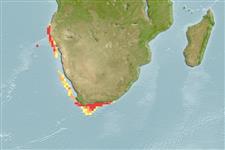
Southeast Atlantic: South Africa and Namibia.
首次成熟时的长度 / 大小 / 重量 / 年龄
成熟度: Lm 9.5 range ? - ? cm
Max length : 17.0 cm SL 雄鱼/尚未辨别雌雄; (Ref. 36731)
简单描述
检索表 | 型态特徵 | 形态测量图
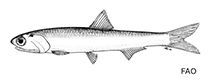
Diagnosis: It hardly differs from the European anchovy (Engraulis encrasicolus); of other anchovies in southern and eastern African waters, species of Stolephorus have 3 to 7 sharp needle-like scutes along the belly, while species of Thryssa have compressed bodies and a keel of scutes along the belly (Ref. 189).
Body shape (shape guide): elongated.
Pelagic in coastal waters, but down to a depth of about 400 m (Ref. 30573). It feeds on planktonic organisms (Ref. 30573). Larvae and juveniles were observed to be selective, raptorial carnivores and switched to non-selective filter feeding omnivory when adults. Caught with purse seines in South Africa and Namibia (Ref. 80687).
生命周期和交配行为
成熟度 | 繁殖 | 产卵场 | 卵 | 孕卵数 | 仔鱼
Bianchi, G., K.E. Carpenter, J.-P. Roux, F.J. Molloy, D. Boyer and H.J. Boyer, 1999. FAO species identification guide for fishery purposes. Field guide to the living marine resources of Namibia. FAO, Rome. 265 p. (Ref. 36731)
世界自然保护联盟红皮书 (Ref. 130435: Version 2025-2 (Global))
人类利用
渔业: 商业性
工具
特别资料
下载 XML
网络资源
基于模型的估算
首选温度 (参考文献
123201): 10.2 - 16.7, mean 13.7 °C (based on 40 cells).
系统发育多样性指数 (参考文献
82804): PD
50 = 0.5020 [Uniqueness, from 0.5 = low to 2.0 = high].
Bayesian length-weight: a=0.00457 (0.00211 - 0.00989), b=3.13 (2.96 - 3.30), in cm total length, based on LWR estimates for this Genus-body shape (Ref.
93245).
营养阶层 (参考文献
69278): 3.0 ±0.1 se; based on size and trophs of closest relatives
Generation time: 1.2 ( na - na) years. Estimated as median ln(3)/K based on 1
growth studies.
回复力 (参考文献
120179): 高度, 族群倍增时间少于 15个月 (Preliminary K or Fecundity.).
Prior r = 0.42, 95% CL = 0.28 - 0.64, Based on 2 full stock assessments.
渔业脆弱性 (Ref.
59153): Low vulnerability (11 of 100).
🛈
气候脆弱性 (Ref.
125649): Low to moderate vulnerability (26 of 100).
🛈
营养素 (Ref.
124155): Calcium = 347 [143, 896] mg/100g; Iron = 1.54 [0.71, 3.72] mg/100g; Protein = 17.9 [16.6, 19.3] %; Omega3 = 0.625 [0.326, 1.241] g/100g; Selenium = 50.5 [20.5, 129.2] μg/100g; VitaminA = 19.5 [4.1, 89.8] μg/100g; Zinc = 1.66 [0.99, 2.78] mg/100g (wet weight);