>
Perciformes/Percoidei (Perchs) >
Percidae (Perches) > Etheostomatinae
Etymology: Etheostoma: Greek, etheo = to strain + Greek, stoma = mouth; Rafinesque said "various mouths", but Jordan and Evermann suggest the name might have been intended as "Heterostoma (Ref. 45335); akatulo: Name akatulo is derived from the Cherokee noun for mask, and as the common name (Bluemask Darter) implies, this refers to the uninterrupted, intense blue pigment covering the lower face of breeding males.
Ambiente: milieu / zona climática / intervalo de profundidade / gama de distribuição
Ecologia
; Água doce bentopelágico; potamódromo (Ref. 126106). Subtropical
North America: USA.
Tamanho / Peso / Idade
Maturidade: Lm ? range ? - ? cm
Max length : 4.8 cm SL macho/indeterminado; (Ref. 80494); 4.5 cm SL (female)
Descrição breve
Chaves de identificação | Morfologia | Morfometria
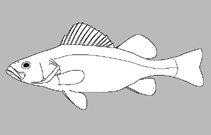
Espinhos dorsais (total) : 10 - 13; Raios dorsais moles (total) : 10 - 12. This species is distinguished from all other species under the subgenus Doration by the combination of the following set of characters: completely scaled cheeks (or nearly
so); lateral line usually complete; breeding males possess an intense blue mask of pigment completely covering lower face and operculum, snout, lips, underside of head, and
branchiostegal membranes; breeding males with soft dorsal and anal fins dark gray to black with no orange spots on rays or blue pigment in membranes (Ref. 80494).
Body shape (shape guide): elongated.
This species is observed in slow to moderate current over sand and fine gravel at depths of 10-50 cm, mainly just downstream of riffles, in runs, or along margins of pools. Breeding males collected in April at the type locality were most abundant in gravelly runs, while breeding females were more common in slower water over sandier substrates adjacent to runs. It is reported to be spawning in May and June in gravelly runs, burying their eggs in small sand patches among the gravel, a similar behavior of E. stigmaeumin aquaria. After the spawning period, it moves to sandy substrates in low-velocity areas of intermediate depth (Ref. 80494).
Ciclo de vida e comportamento de acasalamento
Maturidade | Reprodução | Desova | Ovos | Fecundidade | Larvas
Layman, S.R. and R.L. Mayden, 2009. A new species of the darter subgenus Doration (Percidae: Etheostoma) from the Caney Fork River System, Tennessee. Copeia 2009(1):157-170. (Ref. 80494)
Categoria na Lista Vermelha da IUCN (Ref. 130435: Version 2025-2 (Global))
Ameaçada (EN) (B1ab(iii,v)+2ab(iii,v)); Date assessed: 02 December 2011
Ameaça para o homem
Harmless
Utilização humana
Pescarias: sem interesse
Ferramentas
Relatórios especiais
Descarregue XML
Fontes da internet
Estimativas baseadas em modelos
Índice de diversidade filogenética (Ref.
82804): PD
50 = 0.5000 [Uniqueness, from 0.5 = low to 2.0 = high].
Bayesian length-weight: a=0.00676 (0.00303 - 0.01510), b=3.12 (2.94 - 3.30), in cm total length, based on LWR estimates for this Genus-body shape (Ref.
93245).
Nível Trófico (Ref.
69278): 3.2 ±0.5 se; based on size and trophs of closest relatives
Resiliência (Ref.
120179): Elevada, tempo mínimo de duplicação da população menor que 15 meses (Preliminary K or Fecundity.).
Vulnerabilidade da pesca (Ref.
59153): Low vulnerability (10 of 100).
🛈