Classificação / Nomes
Nomes comuns | Sinónimos | Catalog of Fishes(Género, Espécies) | ITIS | CoL | WoRMS | Cloffa
>
Cypriniformes (Carps) >
Cyprinidae (Minnows or carps) > Labeoninae
Etymology: Garra: Name based on a vernacular Indian name (Hamilton, 1822:343, Ref. 1813); a fish living in mud (Ref. 128817); amirhosseini: Named for Amirhossein, son of the first author.
Eponymy: Amirhossein is the son of the first author. (Ref. 128868), visit book page.
Ambiente: milieu / zona climática / intervalo de profundidade / gama de distribuição
Ecologia
; Água doce bentopelágico. Subtropical
Asia: Sartang-e-Bijar Spring, Tigris River drainage in Iran.
Tamanho / Peso / Idade
Maturidade: Lm ? range ? - ? cm
Max length : 6.7 cm SL macho/indeterminado; (Ref. 109570); peso máx. Publicado: 4.30 g (Ref. 126013)
Descrição breve
Chaves de identificação | Morfologia | Morfometria
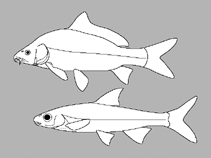
Raios dorsais moles (total) : 10; Raios anais moles: 8. <Garra amirhosseini can be diagnosed from its congeners in the rivers flowing to the Persian Gulf by having the breast and belly with very small scales which are fully covered by a thick epidermal layer (vs. naked breast in G. gymnothorax, naked breast and belly in G. mondica or vs. fully covered by normal scales without any covering layer). It further differs from G. mondica by having a predorsal mid-line which is fully covered by scales or embedded scales (vs. naked or with 2-4 embedded scales at front of dorsal fin origin in a few individuals). It can be further distinguished from G. rufa and G. gymnothorax by having usually 7½ branched rays in dorsal fin (vs. usually 8½). It also differs from G. persica by usually possessing 9+8 caudal-fin rays (vs. usually 8+8); from G. rossica by having a fully developed mental disc (vs. reduced) and 16-20 total gill rakers on the first branchial arch (vs. 13-15); from G. variabilis by having a fully developed mental disc (vs. reduced) and two pairs of barbels (vs. one); and from G. typhlops and G. widdowsoni by having well-developed eyes and a brown and silvery color pattern (vs. absence) (Ref. 109570).
Inhabits hot spring and occurs together with Garra rufa and G. gymnothorax (Ref. 109570).
Ciclo de vida e comportamento de acasalamento
Maturidade | Reprodução | Desova | Ovos | Fecundidade | Larvas
Esmaeili, H.R., G. Sayyadzadeh, B.W. Coad and S. Eagderi, 2016. Review of the genus Garra Hamilton, 1822 in Iran with description of a new species: a morpho-molecular approach (Teleostei: Cyprinidae). Iranian Journal of Ichthyology 3(2):82-121. (Ref. 109570)
Categoria na Lista Vermelha da IUCN (Ref. 130435: Version 2025-2 (Global))
Ameaça para o homem
Harmless
Utilização humana
Pescarias: sem interesse
Ferramentas
Relatórios especiais
Descarregue XML
Fontes da internet
Estimativas baseadas em modelos
Índice de diversidade filogenética (Ref.
82804): PD
50 = 0.5000 [Uniqueness, from 0.5 = low to 2.0 = high].
Bayesian length-weight: a=0.00912 (0.00487 - 0.01708), b=3.09 (2.94 - 3.24), in cm total length, based on LWR estimates for this species & Genus-body shape (Ref.
93245).
Resiliência (Ref.
120179): Elevada, tempo mínimo de duplicação da população menor que 15 meses (Preliminary K or Fecundity.).
Vulnerabilidade da pesca (Ref.
59153): Low vulnerability (10 of 100).
🛈