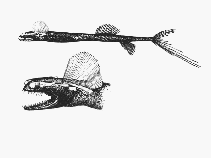
Gigantura indica, Telescopefish

You can sponsor this page

Gigantura indica Brauer, 1901

Telescopefish
Add your observation in Fish Watcher
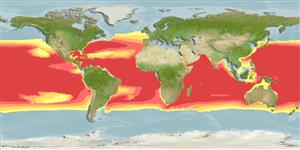
Native range
This map was computer-generated and has not yet been reviewed.
Gigantura indica   AquaMaps   Data sources: GBIF OBIS
Upload your photos and videos
Pictures | Google image
Image of Gigantura indica (Telescopefish)
Gigantura indica
Picture by SFSA

Classification / Names Common names | Synonyms | Catalog of Fishes(genus, species) | ITIS | CoL | WoRMS | Cloffa

Teleostei (teleosts) > Aulopiformes (Grinners) > Giganturidae (Telescopefishes)
Etymology: Gigantura: Latin, gigas, giganteum = giant + Greek, oura = tail (Ref. 45335).

Taxonomic Remarks
Genus B. Mundy, pers. comm.

Environment: milieu / climate zone / depth range / distribution range Ecology

Marine; bathypelagic; depth range 17 - 2100 m (Ref. 58302), usually 500 - 2000 m (Ref. 58302). Deep-water

Distribution Territories | FAO areas | Ecosystems | Occurrences | Point map | Introductions | Faunafri

Circumglobal: In tropical to subtropical waters. Deep sea.

Size / Weight / Age

Maturity: Lm ?  range ? - ? cm
Max length : 26.0 cm TL male/unsexed; (Ref. 121807)

Short description Identification keys | Morphology | Morphometrics

Dorsal spines (total): 0; Dorsal soft rays (total): 16 - 19; Anal spines: 0; Anal soft rays: 11 - 14.
Body shape (shape guide): eel-like.

Biology     Glossary (e.g. epibenthic)

Meso- and bathypelagic (Ref. 58302). The species is rare. Inhabits deep water. Famous for its bizarre shape and unusual eyes.

Life cycle and mating behavior Maturity | Reproduction | Spawning | Eggs | Fecundity | Larvae

Main reference Upload your references | References | Coordinator : Thompson, Bruce | Collaborators

Johnson, R.K. and E. Bertelsen, 1991. The fishes of the family Giganturidae: systematics, development, distribution and aspects of biology. Dana Rept. No. 91:1-45. (Ref. 7449)

IUCN Red List Status (Ref. 130435: Version 2025-2 (Global))

  Least Concern (LC) ; Date assessed: 16 May 2013

CITES

Not Evaluated

CMS (Ref. 116361)

Not Evaluated

Threat to humans

  Harmless


Human uses

Fisheries: of no interest
FAO - Publication: search | FishSource |

More information

Trophic ecology
Food items (preys)
Diet composition
Food consumption
Food rations
Predators
Ecology
Ecology
Population dynamics
Growth parameters
Max. ages / sizes
Length-weight rel.
Length-length rel.
Length-frequencies
Mass conversion
Recruitment
Abundance
Life cycle
Reproduction
Maturity
Maturity/Gills rel.
Fecundity
Spawning
Spawning aggregations
Eggs
Egg development
Larvae
Larval dynamics
Distribution
Territories
FAO areas
Ecosystems
Occurrences
Introductions
BRUVS - Videos
Anatomy
Gill area
Brain
Otolith
Physiology
Body composition
Nutrients
Oxygen consumption
Swimming type
Swimming speed
Visual pigments
Fish sound
Diseases & Parasites
Toxicity (LC50s)
Genetics
Genome
Genetics
Heterozygosity
Heritability
Genetic Diversity
Human related
Aquaculture systems
Aquaculture profiles
Strains
Ciguatera cases
Stamps, coins, misc.
Outreach
Collaborators
References
References

Tools


Fatal error: Uncaught mysqli_sql_exception: Too many connections in /var/www/html/includes/speciessummary.lib.php:1888 Stack trace: #0 /var/www/html/includes/speciessummary.lib.php(1888): mysqli->__construct('mysql', 'fbuser', Object(SensitiveParameterValue), 'fbquizv2', '3306') #1 /var/www/html/summary/SpeciesSummary.php(1851): checkRecordDisplayFBQuizV2('7444', 'PicList') #2 {main} thrown in /var/www/html/includes/speciessummary.lib.php on line 1888