Ikan bertulang rawan (sharks and rays) >
Myliobatiformes (Stingrays) >
Dasyatidae (Stingrays) > Dasyatinae
Etymology: longicauda: Name referring to its very long tail.
Lingkungan: lingkungan / zona iklim / kisaran kedalaman / jangkauan distribusi
Ekologi
laut dasar (demersal); kisaran kedalaman 0 - 1 m (Ref. 94245). Tropical; 8°S - 11°S, 137°E - 148°E (Ref. 114953)
Western Pacific: endemic to southern Guinea.
Ukuran / Berat / umur
Kematangan: Lm ? range ? - ? cm
Max length : 31.0 cm WD jantan/; (Ref. 94245)
deskripsi pendek
Kunci identifiaksi (pengenalan) | Morfologi | Morfometrik
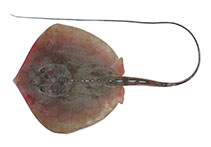
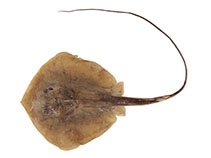
This small species is distinguished by the following combination of characters: plain-coloured with disc subcircular to weakly rhombic, denticle patch developing on central disc with age, continuous row of closely spaced thorns extending along mid-line of disc and tail, small mid-shoulder thorns sometimes present and long tail with dorsal fold reduced to low ridge or none at all, width of disc 1.0-1.1 times its length, trunk depressed; pectoral-fin apex broadly rounded; snout broadly triangular, tip extended slightly anterior margins almost straight; very small eyes, length of orbit and spiracle 2-2.3 in snout length; broad interorbital space, more than 3 times orbit length; narrow mouth with 5 oral papillae; weak labial furrows and folds; lower jaw strongly convex; nasal curtain skirt-shaped, short and broad, the margin weakly fringed, nostrils rather oblique; thorns are spear-shaped or lanceleote, in continuous median row, variable in size and becoming larger posteriorly, 3 nearest caudal sting often greatly enlarged; widely-spaced denticles confined to patched between orbits and on central disc of largest individuals; elongated tail is slender and constricted slightly at sting then becoming whip-like, it length 2.3-2.9 times WD, probably 1 sting; ventral fold elongate, low, (base length about equal to distance from snout to 5th gill slit); dorsal fold often a low ridge or absent; triangular pelvic fin (Ref. 114953).
Body shape (shape guide): other (see remarks); Cross section: flattened.
Little is known about the species but apparently lives mainly nearshore in shallow water. Probably attains more than 31 cm DW or 98 cm TL, no adults known (Ref. 114953). Juvenile specimens caught range from 9.1 to 16.2 cm DW (Ref. 94245).
Siklus hidup dan perilaku kawin
Kematangan | Reproduksi, perkembang biakan | Pemijahan | telur-telur | Fekunditas | Larva
Last, P.R. and W. White, 2013. Two new stingrays (Chondrichthyes: Dasyatidae) from the eastern Indonesian Archipelago. Zootaxa 3722(1):001-021. (Ref. 94245)
Status IUCN Red List (Ref. 130435: Version 2025-2 (Global))
ancaman kepada manusia
Harmless
penggunaan manusia
Alat, peralatan
laporan khas
muat turun XML
Sumber internet
Estimasi berdasarkan model
Indeks keanekaragaman filogenetik (Acuan
82804): PD
50 = 0.5005 [Uniqueness, from 0.5 = low to 2.0 = high].
Bayesian length-weight: a=0.00447 (0.00189 - 0.01058), b=3.12 (2.92 - 3.32), in cm total length, based on LWR estimates for this (Sub)family-body shape (Ref.
93245).
Tingkat Trofik (Acuan
69278): 3.7 ±0.5 se; based on size and trophs of closest relatives
Kerentanan Penangkapan Ikan (Ref.
59153): Very high vulnerability (90 of 100).
🛈