Meio ambiente: milieu / Zona climática / intervalo de profundidade / faixa de distribuição
Ecologia
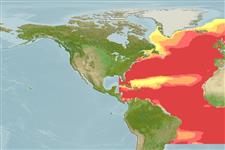
marinhas batipelágico; intervalo de profundidade 100 - 1800 m (Ref. 87004), usually 100 - 1100 m (Ref. 87004). Subtropical; 75°N - 25°S, 85°W - 0°W
Atlantic Ocean: From Iceland to Brazil and Guinea Gulf, from Caribbean to West Africa.
Tamanho / Peso / Idade
Maturidade: Lm ? range ? - ? cm
Max length : 11.0 cm SL macho/indeterminado; (Ref. 123983)
Descrição suscinta
Chaves de identificação | Morfologia | Morfometria
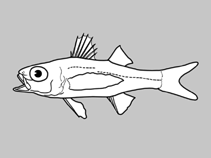
Espinhos dorsais (total) : 7 - 8; Raios dorsais (total) : 10 - 11; Espinhos anais: 3; Raios anais : 7 - 8; Vértebras: 24 - 26. 3 scale rows under the D2 origin down to the lateral line, 10-11 (rarely 12-13) in total. 14-15 pelvic fin rays, rarely 16.
Body shape (shape guide): fusiform / normal; Cross section: compressed.
Individuals 7.5 cm SL and longer mostly occur in the boreal areas, while those less than this the length occur in the tropical areas (Ref. 87004). Maximum length reported in Ref. 87004: 11 cm TL.
Ciclo de vida ou comportamento de acasalamento
Maturidade | Reprodução | Desova | Ovos | Fecundidade | Larvas
Santos, R.S., F.M. Porteiro and J.P. Barreiros, 1997. Marine fishes of the Azores: annotated checklist and bibliography. Bulletin of the University of Azores. Supplement 1. 244 p. (Ref. 35204)
Status na Lista Vermelha da UICN (Ref. 130435: Version 2025-2 (Global))
Ameaça para os humanos
Harmless
Uso pelos humanos
Ferramentas
Relatórios especiais
Baixar XML
Fontes da internet
Estimativas baseadas em modelos
Temperatura preferida (Ref.
123201): 1.7 - 18.6, mean 7.7 °C (based on 1396 cells).
Índice de diversidade filogenética (Ref.
82804): PD
50 = 0.5176 [Uniqueness, from 0.5 = low to 2.0 = high].
Bayesian length-weight: a=0.00389 (0.00180 - 0.00842), b=3.12 (2.94 - 3.30), in cm total length, based on all LWR estimates for this body shape (Ref.
93245).
Nível Trófico (Ref.
69278): 3.4 ±0.4 se; based on size and trophs of closest relatives
Resiliência (Ref.
120179): médio(a), tempo mínimo de duplicação da população 1,4 - 4,4 anos (Fecundity assumed < 1000).
Vulnerabilidade da pesca (Ref.
59153): Low vulnerability (10 of 100).
🛈