Ambiente: milieu / zona climática / intervalo de profundidade / gama de distribuição
Ecologia
marinhas; estuarina associadas(os) a recifes; intervalo de profundidade 0 - 53 m (Ref. 13608), usually ? - 4 m (Ref. 55205). Subtropical; 36°N - 4°S, 100°W - 37°W (Ref. 55205)
Western Atlantic: New Jersey, USA and northern Gulf of Mexico to southern Brazil, including the Antilles (Ref. 3168).
Comprimento na primeira maturidade / Tamanho / Peso / Idade
Maturidade: Lm 81.3, range 75 - 80 cm
Max length : 200 cm WD macho/indeterminado; (Ref. 3168); common length : 90.0 cm WD macho/indeterminado; (Ref. 3168); peso máx. Publicado: 135.6 kg (Ref. 40637); Idade máx. registada: 28 anos (Ref. 53968)
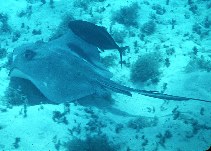
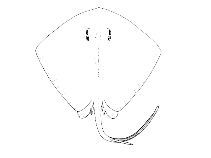
Disk has sharp outer corners and irregular row of short spines on upper surface (Ref. 26938). Disk usually uniform dark brown above, grayer in young. Ventral finfold on tail long and high, dorsal finfold absent (Ref. 7251). Upper surface of disc gray, dark or olivaceous brown or olive green. Lower surface of disc white or whitish with an edging of gray or brown (Ref. 6902).
Body shape (shape guide): other.
Found on sandy bottoms, seagrass beds, lagoons and the reef face (Ref. 12951). Common in bays and estuaries (Ref. 7251). Observed singly, in pairs and in aggregations (Ref. 12951). Buries in the sand during the day and forages at night, usually in seagrass beds (Ref. 12951). Feeds mainly on bivalves and worms and also takes shrimps, crabs and small fishes (Ref. 3168). Feeds by creating depressions in the sand to expose invertebrates and small fishes (Ref. 9710). Ovoviviparous, with 3-4 in a litter (Ref. 12951). May be found in cleaning stations where they are attended to by the bluehead wrasse and Spanish hogfish (Ref. 12951). Equipped with a well-developed serrated spine and capable of inflicting a painful laceration. Easily approached by divers (Ref. 9710).
Ciclo de vida e comportamento de acasalamento
Maturidade | Reprodução | Desova | Ovos | Fecundidade | Larvas
Exhibit ovoviparity (aplacental viviparity), with embryos feeding initially on yolk, then receiving additional nourishment from the mother by indirect absorption of uterine fluid enriched with mucus, fat or protein through specialised structures (Ref. 50449). Distinct pairing with embrace (Ref. 205). Male mounts on female dorsally (Ref. 12951).
Last, P.R., W.T. White, M.R. de Carvalho, B. Séret, M.F.W. Stehmann and G.J.P. Naylor, 2016. Rays of the world. CSIRO Publishing, Comstock Publishing Associates. i-ix + 1-790. (Ref. 114953)
Categoria na Lista Vermelha da IUCN (Ref. 130435: Version 2025-2 (Global))
Ameaça para o homem
Traumatogenic (Ref. 4690)
Utilização humana
Pescarias: espécies comerciais; peixe desportivo: sim
Ferramentas
Relatórios especiais
Descarregue XML
Fontes da internet
Estimativas baseadas em modelos
Temperatura preferida (Ref.
123201): 23.7 - 28.1, mean 27.3 °C (based on 795 cells).
Índice de diversidade filogenética (Ref.
82804): PD
50 = 0.5010 [Uniqueness, from 0.5 = low to 2.0 = high].
Bayesian length-weight: a=0.00447 (0.00189 - 0.01058), b=3.12 (2.92 - 3.32), in cm total length, based on LWR estimates for this (Sub)family-body shape (Ref.
93245).
Nível Trófico (Ref.
69278): 3.5 ±0.0 se; based on diet studies.
Resiliência (Ref.
120179): Baixo, tempo mínimo de duplicação da população 4,5 - 14 anos (tmax=28; Fec=3-4).
Vulnerabilidade da pesca (Ref.
59153): Very high vulnerability (90 of 100).
🛈
Nutrientes (Ref.
124155): Calcium = 5.41 [0.65, 23.15] mg/100g; Iron = 0.355 [0.083, 0.950] mg/100g; Protein = 24.6 [21.7, 27.3] %; Omega3 = 0.145 [0.039, 0.464] g/100g; Selenium = 13.9 [4.1, 41.6] μg/100g; VitaminA = 19.8 [6.4, 64.3] μg/100g; Zinc = 0.592 [0.287, 1.207] mg/100g (wet weight);