Classificação / Nomes
Nomes comuns | Sinónimos | Catalog of Fishes(Género, Espécies) | ITIS | CoL | WoRMS | Cloffa
>
Scombriformes (Mackerels) >
Chiasmodontidae (Snaketooth fishes)
Etymology: Kali: Named after Kali, a Hindu goddess; colubrina: From the Latin coluber, snake; colubrina, feminine, snake-like. In a reference to the numerous recurved teeth in the upper and lower jaws, resembling the snakes of the family Colubridae.
Eponymy: Kali, also known as Kālikā (‘the black one’) is a Hindu goddess, often depicted as having four arms. (Ref. 128868), visit book page.
Ambiente: milieu / zona climática / intervalo de profundidade / gama de distribuição
Ecologia
marinhas batipelágico; intervalo de profundidade 1000 - 2270 m (Ref. 75596), usually 1300 - 1800 m (Ref. 75596). Subtropical
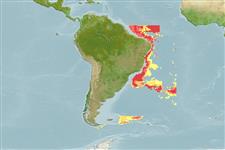
Western Atlantic (88°45’ W-38°19’ W, 27°48’ N and 19°50’ S): N Atlantic (Gulf of Mexico, Straits of Florida, off the Bahamas and Suriname) and S Atlantic (off Brazil). Indo-Pacific (off Indonesia), western South Pacific (off New Zealand) and the Pacific Plate, between 127°36’ E and 169°07’ E, 19°14’ N and 39°49’ S.
Tamanho / Peso / Idade
Maturidade: Lm ? range ? - ? cm
Max length : 17.1 cm SL macho/indeterminado; (Ref. 75596)
Descrição breve
Chaves de identificação | Morfologia | Morfometria
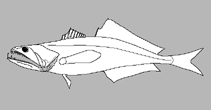
A moderate-sized species of Kali and is distinguished from its congeners by the unique dentition pattern: teeth in lateral series of premaxilla 13-22, type 4, caniniform but not developed as fangs, recurved (vs. teeth in lateral series of premaxilla seven to 22; first tooth developed as fang in K. falx and K. indica; needle-like at least in the
anterior part of dentigerous area in K. kerberti, K. normani, and K. macrura; recurved, with ventral attachment in the posterior dentigerous area in K. macrura and entire dentigerous area in K. parri); teeth in mesial series of premaxilla five to nine, not developed as fangs (vs. teeth in mesial series of premaxilla three in K. falx and K. indica; four to five in K. kerberti, three to four in K. macrura; and six to fifteen in K. parri; developed as fangs in K. falx, K. indica; K. kerberti, and K. macrodon); teeth in lateral series of dentary eight to 18, type 4, caniniform but not very elongated, recurved (vs. teeth in lateral series of dentary seven to 22, elongated in K. falx and K. indica; needle-like at least in the anterior fourth of dentigerous area in K. kerberti, K. normani, and K. macrura; with ventral attachment, recurved, in the posterior dentigerous area in K. macrura, and entire dentigerous area in K. parri); teeth in mesial series of dentary six to ten, not developed as fangs (vs. teeth in mesial series of premaxilla two to four in K. falx and K. indica; four to five in K. kerberti, six to eight in K. macrura; and seven to 19 in K. parri; developed as fangs in K. falx, K. indica; K. kerberti, and K. macrodon).
Body shape (shape guide): elongated.
Ciclo de vida e comportamento de acasalamento
Maturidade | Reprodução | Desova | Ovos | Fecundidade | Larvas
Melo, M.R.S., 2008. The genus Kali Lloyd (Chiasmodontidae: Teleostei) with description of new two species, and the revalidation of K. kerberti Weber. Zootaxa 1747:1-33. (Ref. 75596)
Categoria na Lista Vermelha da IUCN (Ref. 130435: Version 2025-2 (Global))
Ameaça para o homem
Harmless
Utilização humana
Ferramentas
Relatórios especiais
Descarregue XML
Fontes da internet
Estimativas baseadas em modelos
Temperatura preferida (Ref.
123201): 3.2 - 4.4, mean 3.9 °C (based on 31 cells).
Índice de diversidade filogenética (Ref.
82804): PD
50 = 0.5078 [Uniqueness, from 0.5 = low to 2.0 = high].
Bayesian length-weight: a=0.00389 (0.00180 - 0.00842), b=3.12 (2.94 - 3.30), in cm total length, based on all LWR estimates for this body shape (Ref.
93245).
Nível Trófico (Ref.
69278): 3.7 ±0.2 se; based on size and trophs of closest relatives
Vulnerabilidade da pesca (Ref.
59153): Low vulnerability (11 of 100).
🛈