>
Gonorynchiformes (Milkfishes) >
Kneriidae (Shellears)
Etymology: Kneria: From Kner, that studied fishes in the Imperial Museum of Vienna, with Jean Natterer (1817) (Ref. 45335); polli: Named after Dr. Max Poll, who first recognized the opercular apparatus of Xenopomatichthys to be a character of the mature male, and not generic (Ref. 42110).
Eponymy: Dr Rudolf Kner (1810–1869) was an Austrian zoologist specialising in ichthyology. [...] Dr Max Fernand Leon Poll (1908–1991) was a Belgian ichthyologist, and ‘connoisseur of the fish fauna’. [...] (Ref. 128868), visit book page.
More on author: Trewavas.
Ambiente: milieu / zona climatica / distribuzione batimetrica / gamma di distribuzione
Ecologia
; acqua dolce benthopelagico. Tropical; 10°S - 17°S
Africa: rivers Cuvo and Cubal in Angola (Ref. 11970), possibly also in other coastal rivers in Angola (Ref. 52193). Also in the upper reaches of the upper Zambezi, Okavango and Kunene in Angola and Zambia (Ref. 52193), and the Kafue in Zambia (Ref. 13332). Presence in the upper Congo river basin (Ref. 41590, 52959) considered questionable in Ref. 2970, but considered present in the southern Congo River basin in Angola (Ref. 120641). Not yet captured in Namibia (Ref. 33857).
Dimensione / Peso / Età
Maturità: Lm ? range ? - ? cm
Max length : 7.0 cm SL maschio/sesso non determinato; (Ref. 52193)
Breve descrizione
Chiavi di identificazione | Morfologia | Morfometria
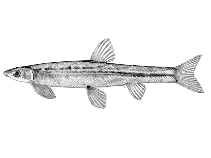
Spine dorsali (totale) : 0; Raggi dorsali molli (totale) : 9 - 11; Spine anali: 0; Raggi anali molli: 10 - 12. Diagnosis: body depth 5.5-6.6 times in standard length (SL); head length 4.75-5.25 times in SL (Ref. 11970, 42110). Head width a little less than head depth at occipital region, 1.75-2 times in head length (HL) (Ref. 42110). Snout 3-3.4 times in HL; eye diameter 3.4-4.17 times in HL; interorbital width 2.75-3.4 times in HL; eyes lateral (Ref. 11970, 42210). Mature males with cupped outgrowth on operculum and a series of oblique laminae behind gill-opening (Ref. 11970, 42110), and without spines on head (Ref. 42110). Dorsal fin origin equidistant from tip of snout and base of caudal (Ref. 11970, 13721, 42110) or nearer mid-base of caudal than tip of snout (Ref. 7248, 52193), above (Ref. 42110) or immediately behind base of pelvic (Ref. 11970, 13721, 42110). Anal fin base equidistant from origin of pelvic and root of caudal (Ref. 42110), or a little nearer caudal (Ref. 11970, 42110). Pectoral fin length 5/6 of head length (Ref. 42110) or nearly as long as head (Ref. 11970, 42110). Pelvic fin as long as or a little shorter than pectoral (Ref. 42110). Caudal peduncle 1.9-2.1 times as long as deep (Ref. 11970, 42110). Body yellowish, with a series of dark spots, united by a narrower band, along lateral line or its posterior 2/3; a series of 3-5 round dark spots on either side of middorsal line in front of dorsal fin; sometimes a spot at origin of dorsal; fainter dark markings along back and side; upper part of head dark, lower parts of head and trunk pale; caudal fin spotted or clear, other fins clear (Ref. 42110). Dark spots at bases of pectoral, ventral and anal fins (Ref. 13721), but no dark spot at base of pelvic fins of type specimens (Ref. 7248, 52193).
Body shape (shape guide): elongated; Cross section: circular.
Ciclo vitale e comportamento di accoppiamento
Maturità | Riproduzione | Deposizione | Uova | Fecondità | Larve
Poll, M., 1984. Kneriidae. p. 129-133. In J. Daget, J.-P. Gosse and D.F.E. Thys van den Audenaerde (eds.) Check-list of the freshwater fishes of Africa (CLOFFA). ORSTOM, Paris and MRAC, Tervuren. Vol. 1. (Ref. 3565)
Stato della Lista Rossa IUCN (Ref. 130435: Version 2025-2 (Global))
Minaccia per l'uomo
Harmless
Usi umani
Strumenti
Rapporti speciali
Scarica XML
Fonti Internet
Stime basate su modelli
Indice di diversità filogenetica (Fonte Biblio.
82804): PD
50 = 0.5000 [Uniqueness, from 0.5 = low to 2.0 = high].
Bayesian length-weight: a=0.00389 (0.00180 - 0.00842), b=3.12 (2.94 - 3.30), in cm total length, based on all LWR estimates for this body shape (Ref.
93245).
Vulnerabilità della pesca (Ref.
59153): Low vulnerability (10 of 100).
🛈