>
Saccopharyngiformes (Swallowers and gulpers) >
Monognathidae (Onejaws)
Etymology: Monognathus: Greek, monos = one + Greek, gnathos = jaw (Ref. 45335); herringi: Named for Peter J. Herring who was of great help to the authors by collecting and preserving Monognathus material on board the "Discovery".
Eponymy: Dr Peter John Herring is an oceanographer and deep-sea biologist, whose bachelor’s degree and doctorate were both awarded by Cambridge. [...] (Ref. 128868), visit book page.
More on authors: Bertelsen & Nielsen.
Ambiente: milieu / zona climatica / distribuzione batimetrica / gamma di distribuzione
Ecologia
marino batipelagico; distribuzione batimetrica 3000 - 5400 m (Ref. 34506). Deep-water
Northeast Atlantic.
Dimensione / Peso / Età
Maturità: Lm ? range ? - ? cm
Max length : 4.8 cm TL maschio/sesso non determinato; (Ref. 34506)
Breve descrizione
Chiavi di identificazione | Morfologia | Morfometria
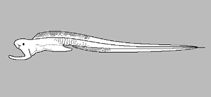
Raggi dorsali molli (totale) : 78; Raggi anali molli: 58. M. herringi differs from the other species of the genus by the following combination of characters: head long with elongate, pointed snout, skull length 6.4% TL, rostral fang strongly hooked with distal part in a nearly right angle to dorsal profile of skull, anal fin origin below myomere number 28, and no lateral, subdermal spots of pigmentation.
Body shape (shape guide): eel-like.
Ciclo vitale e comportamento di accoppiamento
Maturità | Riproduzione | Deposizione | Uova | Fecondità | Larve
Bertelsen, E. and J.G. Nielsen, 1987. The deep sea eel family Monognathidae (Pisces, Anguilliformes). Steenstrupia 13(4):141-198. (Ref. 34506)
Stato della Lista Rossa IUCN (Ref. 130435: Version 2025-2 (Global))
Minaccia per l'uomo
Harmless
Usi umani
Pesca: di nessun interesse
Strumenti
Rapporti speciali
Scarica XML
Fonti Internet
Stime basate su modelli
Indice di diversità filogenetica (Fonte Biblio.
82804): PD
50 = 0.5001 [Uniqueness, from 0.5 = low to 2.0 = high].
Bayesian length-weight: a=0.00102 (0.00046 - 0.00225), b=3.06 (2.88 - 3.24), in cm total length, based on all LWR estimates for this body shape (Ref.
93245).
Livello trofico (Fonte Biblio.
69278): 3.2 ±0.5 se; based on size and trophs of closest relatives
Vulnerabilità della pesca (Ref.
59153): Low vulnerability (10 of 100).
🛈