Entorno: milieu / zona climática / rango de profundidad / gama de distribución
Ecología
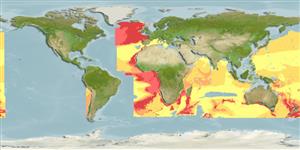
marino batipelágico; rango de profundidad 50 - 2500 m (Ref. 4774). Deep-water; 64°N - 51°S, 77°W - 174°W (Ref. 1371)
Eastern Atlantic: Iceland and Faeroes to Cape Bojador, West Africa, and including Azores, Madeira, and western Mediterranean. Also known from the Walvis and Vavilov ridges (Ref. 45011). Reported from Mauritania (Ref. 55783). Western Indian Ocean: in the region south of Madagascar. Pacific Ocean: temperate Australia, New Zealand, and between Valparaiso, Chile and the Juan Fernandez Islands.
Longitud en la primera madurez / Tamaño / Peso / Edad
Madurez: Lm ?, range 34 - ? cm
Max length : 80.0 cm TL macho / no sexado; (Ref. 9563); common length : 45.0 cm TL macho / no sexado; (Ref. 9258)
Descripción breve
Claves de identificación | Morfología | Morfometría
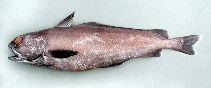
Espinas dorsales (total) : 0; Radios blandos dorsales (total) : 54 - 59; Espinas anales: 0; Radios blandos anales: 18 - 21. Eyes relatively large, greater than snout length in diameter. Anal fin originating near midlength of body, deeply indented at midlength, sometimes appearing as two. Ventral light organ absent. Color is generally gray.
Body shape (shape guide): fusiform / normal; Cross section: oval.
Recorded from the upper continental slope (Ref. 9563). Occasionally found at 50 m. Feeds on fishes, crustaceans, mollusks and other invertebrates as well as food of terrestrial origin, including garbage. Probably a winter and early spring spawner (Ref . 4774). Minimum depth from Ref. 106682.
Cohen, D.M., T. Inada, T. Iwamoto and N. Scialabba, 1990. FAO species catalogue. Vol. 10. Gadiform fishes of the world (Order Gadiformes). An annotated and illustrated catalogue of cods, hakes, grenadiers and other gadiform fishes known to date. FAO Fish. Synop. 125(10). Rome: FAO. 442 p. (Ref. 1371)
Situación en la Lista Roja de la UICN (Ref. 130435: Version 2025-2 (Global))
Amenaza para el ser humano
Harmless
Usos humanos
Pesquerías: escaso valor comercial
Herramientas
Informes especiales
Descargar XML
Fuentes de Internet
Estimaciones basadas en modelos
Temperatura preferida (Referencia
123201): 3.2 - 8.9, mean 5 °C (based on 1437 cells).
Índice de diversidad filogenética (Referencia
82804): PD
50 = 1.0000 [Uniqueness, from 0.5 = low to 2.0 = high].
Bayesian length-weight: a=0.00603 (0.00450 - 0.00807), b=3.15 (3.07 - 3.23), in cm total length, based on LWR estimates for this species (Ref.
93245).
Nivel trófico (Referencia
69278): 3.8 ±0.55 se; based on food items.
Resiliencia (Referencia
120179): Bajo, población duplicada en un tiempo mínimo de 4.5-14 años (Assuming tm>4).
Vulnerabilidad pesquera (Ref.
59153): High to very high vulnerability (69 of 100).
🛈
Vulnerabilidad climática (Ref.
125649): Moderate vulnerability (38 of 100).
🛈
Nutrientes (Ref.
124155): Calcium = 17.7 [5.5, 46.7] mg/100g; Iron = 0.283 [0.126, 0.817] mg/100g; Protein = 18.4 [16.5, 20.1] %; Omega3 = 0.184 [0.071, 0.470] g/100g; Selenium = 21.7 [7.4, 57.4] μg/100g; VitaminA = 18 [2, 134] μg/100g; Zinc = 0.439 [0.244, 0.868] mg/100g (wet weight); based on
nutrient studies.