Elasmobranchi (squali e razze) (sharks and rays) >
Carcharhiniformes (Ground sharks) >
Triakidae (Houndsharks) > Triakinae
Etymology: Mustelus: Latin for weasel, an ancient name for sharks, possibly referring to the pointed snouts, swift movements and/or rapacious feeding behavior of smaller predatory sharks [strictly not tautonymous with Squalus mustelus Linnaeus 1758 since type was designated by the ICZN] (See ETYFish); canis: Latin for dog (sharks were known as “sea dogs” and “dog-fishe” among mariners until the late 16th century, because of their ferocious pack-like feeding behavior) (See ETYFish).
More on author: Mitchill.
Ambiente: milieu / zona climatica / distribuzione batimetrica / gamma di distribuzione
Ecologia
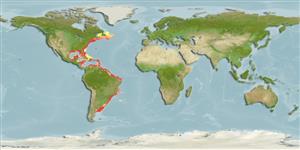
marino; salmastro demersale; oceanodromo (Ref. 51243); distribuzione batimetrica 0 - 800 m (Ref. 55584), usually 18 - 200 m (Ref. 55309). Subtropical; 46°N - 44°S, 98°W - 31°W
Western Atlantic: Massachusetts to Florida (USA), northern and western Gulf of Mexico, Venezuela, Cuba, Jamaica, Barbados, Bermuda, Bahamas; southern Brazil to northern Argentina; also western Gulf of Mexico and Antilles (Ref. 26938). Northwest Atlantic: Canada (Ref. 5951). Allopatric with Mustelus mustelus and sympatric with Mustelus norrisi. One of the two new allopatric species of canis- norrisi-like smooth-hounds in this region is often confused with this species (Ref. 244). The subspecies Mustelus canis insularis, occurring at several Caribbean islands, was identified by Heemstra (Ref. 27770).
Lunghezza alla prima maturità / Dimensione / Peso / Età
Maturità: Lm 99.8, range 95 - 100 cm
Max length : 150 cm TL maschio/sesso non determinato; (Ref. 244); common length : 100.0 cm TL maschio/sesso non determinato; (Ref. 6077); peso massimo pubblicato: 12.2 kg (Ref. 40637)
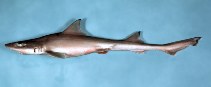
A small, slim shark. Well-serrated dorsal fins, second nearly as large as first (Ref. 26938).
Body shape (shape guide): elongated.
Found on continental and insular shelves and upper slopes, ranging from shallow inshore waters and the intertidal to 200 m, occasionally down to 579 m (Ref. 244). Occasionally found in freshwater. It is doubtful that this species can live in fresh water for an extended period of time (Ref. 244). Active swimmer and bottom feeder (Ref. 27549). Swims in packs or schools (Ref. 27549). Feeds on large crustaceans, mainly crabs, but also heavily on lobsters (Homarus) (Ref. 244). Probably non-territorial. Off the Atlantic coast of the USA, this species is migratory (Ref. 244). Viviparous (with a yolk-sac placenta), with 4 to 20 young in a litter. Longevity given as 7 years (Ref. 775) but appears too low. Utilized fresh, dried-salted, and smoked (Ref. 9987).
Ciclo vitale e comportamento di accoppiamento
Maturità | Riproduzione | Deposizione | Uova | Fecondità | Larve
Viviparous (Ref. 26281, 35307, 50449), with a yolk-sac placenta; with 4 to 20 young per litter. Distinct pairing with embrace (Ref. 205).
Compagno, L.J.V., 1984. FAO Species Catalogue. Vol. 4. Sharks of the world. An annotated and illustrated catalogue of shark species known to date. Part 2 - Carcharhiniformes. FAO Fish. Synop. 125(4/2):251-655. Rome: FAO. (Ref. 244)
Stato della Lista Rossa IUCN (Ref. 130435: Version 2025-2 (Global))
Minaccia per l'uomo
Harmless
Usi umani
Pesca: commerciale; Pesce da pesca sportiva: si
Strumenti
Rapporti speciali
Scarica XML
Fonti Internet
Stime basate su modelli
Temperatura preferita (Fonte Biblio.
123201): 7.8 - 27.5, mean 22.4 °C (based on 1206 cells).
Indice di diversità filogenetica (Fonte Biblio.
82804): PD
50 = 0.5000 [Uniqueness, from 0.5 = low to 2.0 = high].
Bayesian length-weight: a=0.00200 (0.00169 - 0.00236), b=3.12 (3.07 - 3.17), in cm total length, based on LWR estimates for this species (Ref.
93245).
Livello trofico (Fonte Biblio.
69278): 3.6 ±0.2 se; based on diet studies.
Resilienza (Fonte Biblio.
120179): Basso, tempo minimo di raddoppiamento della popolazione 4.5 - 14 anni (K=0.04-0.43; tm=2-5; tmax=7; Fec= 4-20).
Prior r = 0.16, 95% CL = 0.11 - 0.24, Based on 1 full stock assessment.
Vulnerabilità della pesca (Ref.
59153): Moderate to high vulnerability (53 of 100).
🛈
Vulnerabilità climatica (Ref.
125649): High vulnerability (62 of 100).
🛈
Nutrienti (Ref.
124155): Calcium = 11.3 [3.4, 64.4] mg/100g; Iron = 0.387 [0.113, 1.502] mg/100g; Protein = 21.5 [19.2, 23.9] %; Omega3 = 0.145 [0.056, 0.365] g/100g; Selenium = 52.1 [14.6, 197.9] μg/100g; VitaminA = 7.62 [2.46, 23.67] μg/100g; Zinc = 0.793 [0.339, 1.664] mg/100g (wet weight);