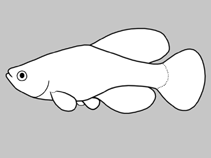
Classificação / Nomes
Nomes comuns | Sinónimos | Catalog of Fishes(Género, Espécies) | ITIS | CoL | WoRMS | Cloffa
>
Cyprinodontiformes (Rivulines, killifishes and live bearers) >
Nothobranchiidae (African rivulines)
Etymology: Nothobranchius: Greek, nothos = false + Greek, brangchia = gill (Ref. 45335); krysanovi: The species is named in honour of Prof. Eugeny Y. Krysanov, a scientist at the Russian Academy of Sciences, who carried out cytological studies on Nothobranchius species, as well as the effects of radiation on their chromosomes in the Chernobyl area; the species name is pronounced 'kree-sa-nofi' (Ref. 85866).
Eponymy: Eugeny Y Krysanov is a scientist at the Severtsov Institute of Ecology and Evolution, Russian Academy of Sciences. [...] (Ref. 128868), visit book page.
Ambiente: milieu / zona climática / intervalo de profundidade / gama de distribuição
Ecologia
; Água doce bentopelágico. Tropical
Africa: ephemeral pools and swamps on floodplains in coastal lowlands north of the lower Zambezi River in east-central Mozambique (Ref. 85866).
Tamanho / Peso / Idade
Maturidade: Lm ? range ? - ? cm
Max length : 3.1 cm SL macho/indeterminado; (Ref. 85866); 3.0 cm SL (female)
Descrição breve
Chaves de identificação | Morfologia | Morfometria
Espinhos dorsais (total) : 0; Raios dorsais moles (total) : 15 - 17; Espinhos anais: 0; Raios anais moles: 15 - 17. Diagnosis: Nothobranchius krysanovi is distinguished from other species of the genus Nothobranchius by the following combination of characters: males with bright colouration consisting of alternating light blue and orange-red oblique bars on body, dorsal and anal fins, and orange-brown caudal fin with orange subterminal and black terminal band; female with faint brown oblique bars on posterior part of flanks (Ref. 85866). It can be distinguished from the other species of the subgenus Nothobranchius as follows: from N. furzeri by male colouration, higher number of dorsal fin rays, 15-17 vs. 14-15; from N. kadleci by male colouration and shape of the frontal region, higher number of dorsal and anal fin rays, 15-17 vs. 13-14 and 15-17 vs. 13-14; and from N. orthonotus by male and female colouration, and lower number of scales on the mid-longitudinal series, 27-29 vs. 28-33 (Ref. 85866). Nothobranchius krysanovi can also be distinguished from N. rachovii by its higher number of diploid chromosomes, 2n=18 vs. 2n=16; and from N. pienaari by its much lower diploid chromosome number, 2n=18 vs. 2n=34 (Ref. 85866).
Body shape (shape guide): fusiform / normal.
Found in ephemeral pools and swamps on floodplains; water level in the habitats is subject to seasonal changes and generally the water disappears completely during the dry season (Ref. 85866). Grass vegetation is usually found near the habitat margins; much of the swamps may be utilised by local inhabitants for the cultivation of rice; aquatic vegetation may comprise Nymphea, Ottelia, Lagarosiphon and Utricularia species (Ref. 85866). It has an annual mode of reproduction (Ref. 85866).
Ciclo de vida e comportamento de acasalamento
Maturidade | Reprodução | Desova | Ovos | Fecundidade | Larvas
Shidlovskiy, K.M., B.R. Watters and R.H. Wildekamp, 2010. Notes on the annual killifish species Nothobranchius rachovii (Cyprinodontiformes; Nothobranchiidae) with the description of two new species. Zootaxa 2724:37-57. (Ref. 85866)
Categoria na Lista Vermelha da IUCN (Ref. 130435: Version 2025-2 (Global))
Ameaça para o homem
Harmless
Utilização humana
Ferramentas
Relatórios especiais
Descarregue XML
Fontes da internet
Estimativas baseadas em modelos
Índice de diversidade filogenética (Ref.
82804): PD
50 = 0.5000 [Uniqueness, from 0.5 = low to 2.0 = high].
Bayesian length-weight: a=0.01096 (0.00461 - 0.02608), b=2.94 (2.74 - 3.14), in cm total length, based on LWR estimates for this (Sub)family-body shape (Ref.
93245).
Nível Trófico (Ref.
69278): 3.1 ±0.4 se; based on size and trophs of closest relatives
Vulnerabilidade da pesca (Ref.
59153): Low vulnerability (10 of 100).
🛈