Elasmobranchii (tubarões e raias) (sharks and rays) >
Rajiformes (Skates and rays) >
Arhynchobatidae (Softnose skates)
Etymology: Notoraja: Greek, noton = back + Latin, raja = fish, Raja sp. (Ref. 45335); martinezi: Named for Jimmy Martínez, an Ecuadorian Biologist.
Ambiente: milieu / zona climática / intervalo de profundidade / gama de distribuição
Ecologia
marinhas batidemersal; intervalo de profundidade 1256 - 1472 m (Ref. 117110). Deep-water
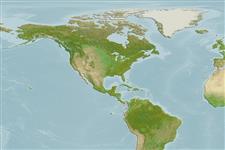
Eastern Pacific, between Costa Rica and Ecuador.
Tamanho / Peso / Idade
Maturidade: Lm ? range ? - ? cm
Max length : 47.5 cm TL macho/indeterminado; (Ref. 117110); 34.6 cm TL (female)
Descrição breve
Chaves de identificação | Morfologia | Morfometria
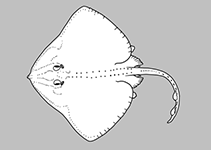
This heart-shaped, medium-size species is distinguished by the following characters: dark brownish dorsal and ventral surface; the disc is slightly wider 54.7 (51.7-55.2) %TL than long 51.6 (49.0-54.3) %TL; dorsal head length 21.3 (18.9-20.4) %TL; interspiracular width 6.3 (6.6-7.6) %TL; internarial space 8.4 (6.6-7.9) %TL; preorbital length 14.9 (13.0-14.9) %TL, 4.4 (3.8-4.9) times orbit length and 3.0 (2.9-3.3) times distance between eyes (interorbital space); tail width
at pelvic fin axil 1.5 (1.3-1.4) times its height; presence of a single, strong, hook-like, angled posteriorly preorbital thorn; disk with small, fine denticles, randomly distributed, slightly more abundant on the sides of the caudal region; long claspers (cloacal length) 23.8% TL and slim; long and slender tail, covered with abundant strong, thin, non aligned and posteriorly angled thorns, which differs from all other congeners; thin lateral tail folds merging at tail axil, thinner than tail width at any point and enlarged posteriorly; nasal lobes are expanded, nasal curtain maximum width 8.4 (7.8-9.5) %TL; anterior pelvic-fin lobe is longer than posterior 13.1 (16.2-16.8) %TL and 10.1 (7.8-9.8)% TL when straightened (shorter than posterior in natural position though); total pectoral-fin radials 65 (63-65); monospondylus centra 25 (24-26); predorsal diplospondylous centra 58 (60-65); total predorsal centra 83 (85-91); caudal centra 20 (22-25) total centra 118 (123-128) (Ref. 117110).
Body shape (shape guide): other (see remarks); Cross section: flattened.
Female maturity and size at birth not known (but the smallest specimen taken was 24.3 cm TL) (Ref. 117110).
Ciclo de vida e comportamento de acasalamento
Maturidade | Reprodução | Desova | Ovos | Fecundidade | Larvas
Concha, F.J., D.A. Ebert and D.J. Long, 2016. Notoraja martinezi sp. nov., a new species of deepwater skate and the first record of the genus Notoraja Ishiyama, 1958 (Rajiformes: Arhynchobatidae) from the eastern Pacific Ocean. Zootaxa 4098(1):179-190. (Ref. 117110)
Categoria na Lista Vermelha da IUCN (Ref. 130435: Version 2025-2 (Global))
Ameaça para o homem
Harmless
Utilização humana
Pescarias: sem interesse
Ferramentas
Relatórios especiais
Descarregue XML
Fontes da internet
Estimativas baseadas em modelos
Índice de diversidade filogenética (Ref.
82804): PD
50 = 0.5000 [Uniqueness, from 0.5 = low to 2.0 = high].
Bayesian length-weight: a=0.00550 (0.00279 - 0.01081), b=3.11 (2.94 - 3.28), in cm total length, based on LWR estimates for this (Sub)family-body shape (Ref.
93245).
Nível Trófico (Ref.
69278): 3.8 ±0.7 se; based on size and trophs of closest relatives
Resiliência (Ref.
120179): Médio, tempo mínimo de duplicação da população 1,4 - 4,4 anos (Preliminary K or Fecundity.).
Vulnerabilidade da pesca (Ref.
59153): Moderate vulnerability (38 of 100).
🛈