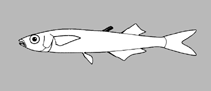
>
Atheriniformes (Silversides) >
Atherinopsidae (Neotropical silversides) > Atherinopsinae
Etymology: Odontesthes: Greek, odous = teeth + Greek,esthes = suit, something used to wrap (Ref. 45335).
Ambiente: milieu / zona climática / intervalo de profundidade / gama de distribuição
Ecologia
; Água doce demersal. Tropical
South America: upper rio Uruguay and rio Passo Fundo in Brazil.
Tamanho / Peso / Idade
Maturidade: Lm ? range ? - ? cm
Max length : 16.9 cm SL macho/indeterminado; (Ref. 116661)
Descrição breve
Chaves de identificação | Morfologia | Morfometria
Raios anais moles: 15 - 17. Odontesthes yucuman is diagnosed from other species of Odontesthes, except members of the O. perugiae species-group (O. bicudo, O. ledae, O. mirinensis, O. piquava and O. perugiae) by having the following combination of characters: teeth of the outer row on dentary and premaxilla shorter than those in the inner row (vs. teeth of outer row larger than those of inner row or teeth of outer and inner rows of equal size); origin of dorsal fin positioned over or posterior to anus (vs. anterior to anus); and 7 to 9 longitudinal scale rows above left and right lateral bands. It differs from O. bicudo, O. ledae, O. mirinensis, and O. piquava by having 19-25 lower branch gill rakers (vs. 26-29 in O. ledae, 24-29 in O. mirinensis, 25-31 in O. bicudo, and 27-28 in O. piquava); and from O. perugiae by the differences in the snout length (35.6-39.5, mean 37.7 vs. 28.6-37.4%, mean 32.2 of HL), and the distance between snout tip and posterior angle of labial ligament (31.3 -37.0, mean vs. 23.6 -33.1%, mean 28.2 of HL (Ref. 116661).
Body shape (shape guide): elongated.
Collected from reservoirs or immediately downstream of three Hydroelectric Power Plants of the rio Uruguay basin (Itá, Machadinho and Monjolinho). Occurs sympatrically with O. bonariensis (Valenciennes) and O. humensis de Buen in the upper rio Uruguay (Ref. 116661).
Ciclo de vida e comportamento de acasalamento
Maturidade | Reprodução | Desova | Ovos | Fecundidade | Larvas
Wingert, J.M., J. Ferrer and L.R. Malabarba, 2017. Review of the Odontesthes perugiae species group from Río de La Plata drainage, with the description of a new species (Atherinomorpha: Atherinopsidae). Zootaxa 4250(6):501-528. (Ref. 116661)
Categoria na Lista Vermelha da IUCN (Ref. 130435: Version 2025-2 (Global))
Ameaça para o homem
Harmless
Utilização humana
Ferramentas
Relatórios especiais
Descarregue XML
Fontes da internet
Estimativas baseadas em modelos
Índice de diversidade filogenética (Ref.
82804): PD
50 = 0.5000 [Uniqueness, from 0.5 = low to 2.0 = high].
Bayesian length-weight: a=0.00550 (0.00240 - 0.01261), b=3.05 (2.87 - 3.23), in cm total length, based on LWR estimates for this Genus-body shape (Ref.
93245).
Nível Trófico (Ref.
69278): 3.5 ±0.3 se; based on size and trophs of closest relatives
Resiliência (Ref.
120179): Elevada, tempo mínimo de duplicação da população menor que 15 meses (Preliminary K or Fecundity.).
Vulnerabilidade da pesca (Ref.
59153): Low vulnerability (11 of 100).
🛈