>
Salmoniformes (Salmons) >
Salmonidae (Salmonids) > Salmoninae
Etymology: Oncorhynchus: Greek, onyx, -ychos = nail + Greek, rhyngchos = snout (Ref. 45335); clarkii: Named after William Clark, leader of the Lewis and Clark expedition (Ref. 1998).
Eponymy: Captain William Clark (1770–1838) was an American explorer and soldier who later became Governor of Missouri Territory. [...] (Ref. 128868), visit book page.
More on author: Richardson.
Taxonomic Remarks
Synonymy to clarify with Oncorhynchus clarkii lewisi (Girard, 1856) [or Suckley, 1874?].
Ambiente: milieu / zona climática / intervalo de profundidade / gama de distribuição
Ecologia
marinhas; Água doce; estuarina demersal; anádromo (Ref. 27547); intervalo de profundidade 0 - 200 m (Ref. 50610). Temperate; ? - 23°C (Ref. 12741); 61°N - 40°N
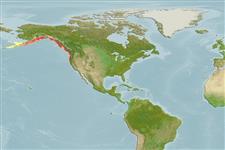
Eastern Pacific: northern parts of Prince William Sound, Alaska, south to the Eel River in northern California, USA and is found in most streams emptying into the Pacific.
Widely introduced into various streams and lakes within its natural range, as well as into a few lakes in eastern North America. In some streams it may be the most numerous sport fish present, while other streams support only small populations. At least 14 subspecies have been historically recognized (Ref. 5723).
Comprimento na primeira maturidade / Tamanho / Peso / Idade
Maturidade: Lm 15.2, range 15 - 18 cm
Max length : 99.0 cm TL macho/indeterminado; (Ref. 12204); peso máx. Publicado: 18.6 kg (Ref. 9988); Idade máx. registada: 13 anos (Ref. 119181)
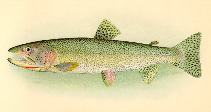
Espinhos dorsais (total) : 0; Raios dorsais moles (total) : 8 - 11; Espinhos anais: 0; Raios anais moles: 8 - 12. Color is variable. Generally dark green to greenish-blue on back, olive-green on upper flank, silvery on lower flank and belly; flanks spots below lateral line are more numerous anteriorly; irregular spots on dorsal, adipose and caudal fins and the anal, pectoral and pelvic fin bases; gill covers are pinkish. Those found at sea or recent migrants to freshwater are silvery with a bluish back, yellowish lower flanks and fins, and sparse spots.
Body shape (shape guide): fusiform / normal; Cross section: oval.
Prefers relatively small streams, with gravel bottoms and gentle gradients. Spawning adults migrate from the sea into streams to spawn (Ref. 27547). The young fish usually stay in the stream for a year or two before entering the sea, but some populations never got to sea at all. In rare cases, some individuals of sea-going populations, may remain in fresh water for as long as eight years (Ref. 28866, 28869). Feeds on small fishes, crustaceans, and insects (Ref. 4925). The flesh is orange-red and of excellent flavor (Ref. 27547). Utilized fresh and eaten fried, broiled, and baked (Ref. 9988). This species does not compete well with other fish, tends to hybridize, and is unable to withstand fishing pressure = depletion of stocks.
Spawning occurs both daytime and nighttime. The female selects a site and builds a redd while the male courts her and drives away other males. Upon completion of the redd, the female settles into the pitt, immediately followed by the male. The pair releases eggs and sperm simultaneously and the eggs fall into the spaces between the gravel. The female then moves to the upstream edge of the redd and resumes digging, thereby covering the eggs. When completely covered, the female may use the new redd to spawn once more or she may look for another spot and repeat the entire process. Both males and females spawn with one or more members of the opposite sex (Ref. 12204, 27547). Reproductive strategy: synchronous ovarian organization, determinate fecundity (Ref. 51846).
Coad, B.W., 1995. Encyclopedia of Canadian fishes. Canadian Museum of Nature and Canadian Sportfishing Productions Inc. Singapore. (Ref. 12204)
Categoria na Lista Vermelha da IUCN (Ref. 130435: Version 2025-2 (Global))
Ameaça para o homem
Harmless
Utilização humana
Pescarias: espécies comerciais; Aquacultura: espécies comerciais; peixe desportivo: sim; Aquário: Aquários públicos
Ferramentas
Relatórios especiais
Descarregue XML
Fontes da internet
Estimativas baseadas em modelos
Temperatura preferida (Ref.
123201): 6.1 - 9.7, mean 8.1 °C (based on 81 cells).
Índice de diversidade filogenética (Ref.
82804): PD
50 = 0.5000 [Uniqueness, from 0.5 = low to 2.0 = high].
Bayesian length-weight: a=0.00891 (0.00713 - 0.01114), b=3.02 (2.98 - 3.06), in cm total length, based on LWR estimates for this species (Ref.
93245).
Nível Trófico (Ref.
69278): 3.8 ±0.56 se; based on food items.
Generation time: 4.4 ( na - na) years. Estimated as median ln(3)/K based on 1
growth studies.
Resiliência (Ref.
120179): Médio, tempo mínimo de duplicação da população 1,4 - 4,4 anos (tm=2-3; tmax=10; Fec=226).
Vulnerabilidade da pesca (Ref.
59153): Moderate to high vulnerability (48 of 100).
🛈