Ikan bertulang rawan (sharks and rays) >
Orectolobiformes (Carpet sharks) >
Orectolobidae (Carpet or nurse sharks)
Etymology: Orectolobus: orektos (Gr.), stretched out; lobus (L.), from lobos (Gr.), rounded projection or protuberance, referring to long nasal barbels of Squalus barbatus (=O. maculatus) (See ETYFish); maculatus: Latin for spotted, referring to large, 0-shaped markings that densely cover dorsal surface (See ETYFish).
More on author: Bonnaterre.
Lingkungan: lingkungan / zona iklim / kisaran kedalaman / jangkauan distribusi
Ekologi
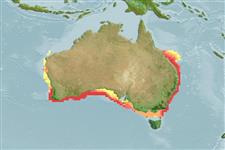
laut berasosiasi dengan karang; kisaran kedalaman 0 - 248 m (Ref. 106604), usually 0 - 110 m (Ref. 247). Temperate; 20°S - 40°S, 113°E - 154°E
Eastern Indian Ocean: southern Australia, from Western Australia to southern Queensland. Records from Japan and the South China Sea need to be confirmed.
Panjang pada saat jatuh tempo pertama / Ukuran / Berat / umur
Kematangan: Lm ?, range 60 - ? cm
Max length : 320 cm TL jantan/; (Ref. 247); common length : 180 cm TL jantan/; (Ref. 247)
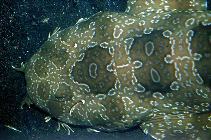
Duri punggung (Keseluruhan (total)) : 0; Duri dubur: 0. Back dark, with light O-shaped markings obscuring darker saddles (Ref. 13577). Caudal fin with its upper lobe hardly elevated above the body axis, with a strong terminal lobe and subterminal notch but no ventral lobe (Ref. 13577).
Body shape (shape guide): elongated.
Found on the continental shelf, from the intertidal down to at least 110 m (Ref. 247). Commonly on coral and rocky reefs, under piers, and on sand bottom (Ref. 247). May occur in water barely deep enough to cover the fish, and has been observed climbing ridges between tide pools with its back out of water (Ref. 247). Nocturnal (Ref. 247). Feeds on bottom invertebrates (Ref. 247), including crabs, lobsters and octopuses (Ref. 43278), and bony fishes (Ref. 247), like sea bass, scorpionfishes and luderick (Ref. 43278). Ovoviviparous (Ref. 43278, 50449), with up to 37 pups in a litter (Ref. 247). Known to bite people that step on it or put their feet near its mouth, and can and will bite when molested and provoked (Ref. 247). Flesh highly regarded and sometimes utilized for human consumption (Ref. 247). Skin sometimes utilized for leather (Ref. 247). Regarded as pest by lobster fishers (Ref. 247).
Ovoviviparous, embryos feed solely on yolk (Ref. 50449). One female had 37. Size at birth about 21 cm. Some anecdotal accounts regarding courtship are given. It is said that males in captivity fight vigorously among themselves while courting females. In the process, females are bitten by males in the gill region and one clasper is inserted. In the wild, the males are attracted to the females by some chemical pheromones possibly released by the latter during the breeding season.
Compagno, L.J.V., 1984. FAO Species Catalogue. Vol. 4. Sharks of the world. An annotated and illustrated catalogue of shark species known to date. Part 1 - Hexanchiformes to Lamniformes. FAO Fish. Synop. 125(4/1):1-249. Rome, FAO. (Ref. 247)
Status IUCN Red List (Ref. 130435: Version 2025-2 (Global))
penggunaan manusia
Perikanan: nilai komersial kecil
Alat, peralatan
laporan khas
muat turun XML
Sumber internet
Estimasi berdasarkan model
Suhu yang disukai (Acuan
123201): 15.3 - 24.4, mean 18 °C (based on 290 cells).
Indeks keanekaragaman filogenetik (Acuan
82804): PD
50 = 0.5012 [Uniqueness, from 0.5 = low to 2.0 = high].
Bayesian length-weight: a=0.00389 (0.00180 - 0.00842), b=3.12 (2.94 - 3.30), in cm total length, based on all LWR estimates for this body shape (Ref.
93245).
Tingkat Trofik (Acuan
69278): 4.2 ±0.64 se; based on food items.
Generation time: 5.5 ( na - na) years. Estimated as median ln(3)/K based on 1
growth studies.
Daya lenting (Acuan
120179): Rendah, Waktu penggandaan populasi minimum 4.5 - 14 tahun (Fec=37).
Kerentanan Penangkapan Ikan (Ref.
59153): High vulnerability (61 of 100).
🛈
Nutrisi (Ref.
124155): Calcium = 2.26 [0.36, 9.58] mg/100g; Iron = 0.116 [0.027, 0.322] mg/100g; Protein = 20.2 [17.9, 22.4] %; Omega3 = 0.234 [0.093, 0.566] g/100g; Selenium = 12.4 [3.3, 39.0] μg/100g; VitaminA = 14.1 [3.5, 52.4] μg/100g; Zinc = 0.248 [0.117, 0.533] mg/100g (wet weight);