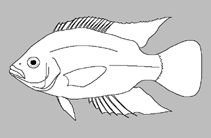
Classificação / Nomes
Nomes comuns | Sinónimos | Catalog of Fishes(Género, Espécies) | ITIS | CoL | WoRMS | Cloffa
>
Cichliformes (Cichlids, convict blennies) >
Cichlidae (Cichlids) > Pseudocrenilabrinae
Etymology: Otopharynx: Greek, ous = hear + Greek, pharyngx = pharynx (Ref. 45335); peridodeka: From the Greek adverb περι (peri: around, near) and noun δυώδεκα (duódeka: 12), refering to the usually 12 lower-limb gill rakers of this species, a character separating it from the similar-looking Otopharynx panniculus with a higher count; the compound is treated as a noun in apposition (Ref. 119408).
Ambiente: milieu / zona climática / intervalo de profundidade / gama de distribuição
Ecologia
; Água doce bentopelágico. Tropical
Africa: Lake Malawi off Sungu Point in Malawi (Ref. 119408).
Tamanho / Peso / Idade
Maturidade: Lm ? range ? - ? cm
Max length : 9.2 cm SL macho/indeterminado; (Ref. 119408)
Descrição breve
Chaves de identificação | Morfologia | Morfometria
Espinhos dorsais (total) : 16 - 17; Raios dorsais moles (total) : 10 - 13; Espinhos anais: 3; Raios anais moles: 8 - 10. Diagnosis: A small, laterally spotted haplochromine recognizable by the following combination of characters: spots often indistinct, the suprapectoral spot, when discernible, vaguely rectangular, centered on subdorsal bar 3 or connecting bars 3 and 4, and covering four to five consecutive lateral-line scales, extending vertically from just above lateral midline to half a scale above upper lateral line; about seven vertical gray bars below dorsal-fin base; 34-35 scales in lateral line; 11-13 gill rakers on lower limb; 48-73 teeth in outer row of upper jaw; lower pharyngeal bone with a few posteromedian teeth enlarged, submolariform to molariform; lacrimal bone lacking a notch at base of lacrimal process (Ref. 119408). Otopharynx peridodeka is superficially most similar to O. panniculus, which also lacks a lacrimal notch, but O. peridodeka has more scales in the lateral line, 34-35 vs. 31-33, usually fewer lower gill rakers, 11-13 vs. 13-15, posteromedian pharyngeal teeth distinctly enlarged relatively to more lateral teeth vs. median and lateral teeth of nearly uniform size, averages fewer teeth in the posterior row of the lower pharyngeal bone, 37-44 vs. 42-48, and has a deeper lacrimal bone, 19.9-24.7% of head length vs. 18.1-19.9% (Ref. 119408). Compared to O. aletes, O. peridodeka has the hemijaws in ventral view posteriorly convergent, approximated vs. divergent, distant; and lower pharyngeal bone more lightly built, with narrower posterior horns, posteromedian teeth somewhat enlarged but laterally compressed, cuspidate vs. bone heavier, horns thickened, posterior teeth of median rows enlarged, crowns molarized, nearly hemispherical (Ref. 119408). Trematocranus brevirostris is somewhat similar, but in Otopharynx peridodeka the suprapectoral spot is rectangular, covering four to five longitudinal scales, and is located almost entirely below the upper lateral line vs. taller than long, covering three scales and, at least in the lectotype, placed more above than below the upper lateral line; the cephalic lateral-line system is not enlarged vs. pores and canals of the preorbital, nasal, dentary, and lacrimal bones inflated; and there are 48-73 outer upper-jaw teeth vs. about 43 (Ref. 119408).
Body shape (shape guide): short and / or deep.
Ciclo de vida e comportamento de acasalamento
Maturidade | Reprodução | Desova | Ovos | Fecundidade | Larvas
Oliver, M.K., 2018. Six new species of the Cichlid genus Otopharynx from Lake Malaŵi (Teleostei: Cichlidae). Bulletin of the Peabody Museum of Natural History 59(2):159-197. (Ref. 119408)
Categoria na Lista Vermelha da IUCN (Ref. 130435: Version 2025-2 (Global))
Ameaça para o homem
Harmless
Utilização humana
Ferramentas
Relatórios especiais
Descarregue XML
Fontes da internet
Estimativas baseadas em modelos
Índice de diversidade filogenética (Ref.
82804): PD
50 = 0.5000 [Uniqueness, from 0.5 = low to 2.0 = high].
Bayesian length-weight: a=0.00389 (0.00180 - 0.00842), b=3.12 (2.94 - 3.30), in cm total length, based on all LWR estimates for this body shape (Ref.
93245).
Nível Trófico (Ref.
69278): 3.4 ±0.4 se; based on size and trophs of closest relatives
Resiliência (Ref.
120179): Elevada, tempo mínimo de duplicação da população menor que 15 meses (Preliminary K or Fecundity.).
Vulnerabilidade da pesca (Ref.
59153): Low vulnerability (10 of 100).
🛈