>
Perciformes/Percoidei (Perchs) >
Percidae (Perches) > Etheostomatinae
Etymology: Percina: Latin, diminutive of perch = perch (Ref. 45335); burtoni: Named after E. Milby Burton, former noted naturalist at the Charleston Museum who collected the type (Ref. 10294).
Eponymy: Edward Milby Burton (1898–1977) was originally a Charleston insurance broker who was Director of the Charleston Museum, South Carolina (1932–1972). [...] (Ref. 128868), visit book page.
More on author: Fowler.
Ambiente: milieu / zona climática / intervalo de profundidade / gama de distribuição
Ecologia
; Água doce bentopelágico. Temperate; 38°N - 35°N
North America: Tennessee and Cumberland River drainages in Virginia, North Carolina, Kentucky and Tennessee, USA.
Tamanho / Peso / Idade
Maturidade: Lm ? range ? - ? cm
Max length : 16.0 cm TL macho/indeterminado; (Ref. 5723); common length : 11.0 cm TL macho/indeterminado; (Ref. 12193); Idade máx. registada: 4 anos (Ref. 12193)
Descrição breve
Chaves de identificação | Morfologia | Morfometria
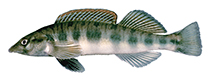
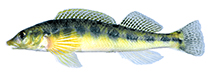
Espinhos dorsais (total) : 15 - 18; Raios dorsais moles (total) : 13 - 17. Percina burtoni is distinguished from its congener P. apina by having lower mean number of lateral line scales (89.92 vs. 93.09), pored lateral line scales (88.78 vs. 91.59), transverse scale rows (33.59 vs. 38.09), and scales around the caudal peduncle (33.54 vs. 36.22); shape of the midlateral blotches tend to be higher than wide (vs. typically wider than high in P. apina); all blotches are distinctly round in shape (vs. posteriormost blotches ovoid or rectangular in shape in P. apina); pigmentation is diffuse at the ventral margins of the blotches (pigmentation along the edges of the blotches is sharply defined in P. apina) (Ref. 116752).
Body shape (shape guide): elongated.
Inhabits gravel runs and riffles of clear, small to medium rivers (Ref. 5723, 10294); also found in creeks (Ref. 10294). Feeds on mayfly, caddisfly, stonefly, midge, and blackfly larvae and adult and larval riffle beetles (Ref. 10294).
Ciclo de vida e comportamento de acasalamento
Maturidade | Reprodução | Desova | Ovos | Fecundidade | Larvas
Page, L.M. and B.M. Burr, 1991. A field guide to freshwater fishes of North America north of Mexico. Houghton Mifflin Company, Boston. 432 p. (Ref. 5723)
Categoria na Lista Vermelha da IUCN (Ref. 130435: Version 2025-2 (Global))
Ameaça para o homem
Harmless
Utilização humana
Ferramentas
Relatórios especiais
Descarregue XML
Fontes da internet
Estimativas baseadas em modelos
Índice de diversidade filogenética (Ref.
82804): PD
50 = 0.5000 [Uniqueness, from 0.5 = low to 2.0 = high].
Bayesian length-weight: a=0.00575 (0.00268 - 0.01234), b=3.13 (2.95 - 3.31), in cm total length, based on LWR estimates for this (Sub)family-body shape (Ref.
93245).
Nível Trófico (Ref.
69278): 3.4 ±0.5 se; based on size and trophs of closest relatives
Resiliência (Ref.
120179): Médio, tempo mínimo de duplicação da população 1,4 - 4,4 anos (tmax=4).
Vulnerabilidade da pesca (Ref.
59153): Low vulnerability (10 of 100).
🛈