Environnement : milieu / zone climatique / profondeur / gamme de distribution
Écologie
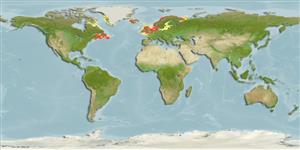
marin; saumâtre démersal; non migrateur; profondeur 0 - 100 m (Ref. 48978), usually 0 - 30 m (Ref. 35388). Polar; 72°N - 43°N, 76°W - 45°E
North Atlantic: Kanin Peninsula southward to La Rochelle (including White Sea, North Sea and Baltic), also Iceland, but not eastern Greenland, Spitzbergen or Novaya Zemlya. Western Atlantic: Labrador, Canada to Delaware Bay, USA (Ref. 7251).
Taille / Poids / Âge
Maturité: Lm ? range ? - ? cm
Max length : 25.0 cm SL mâle / non sexé; (Ref. 4693); âge max. reporté: 5 années (Ref. 72462)
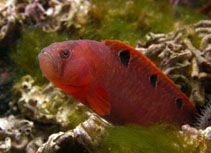
Ribbon - shaped body with 9 - 13 eye spots along the base of the dorsal fin (Ref. 35388).
Body shape (shape guide): eel-like.
Facultative air-breathing (Ref. 126274); Occurs in shallow waters (seashore, tide pools), but descends (especially in winter) to 100 m or more. May remain out of water under rocks or seaweeds (Ref. 31184). Feeds on small crustaceans, polychaetes, mollusks and fish eggs. The eggs are laid on the sea bed in a large clump, which is closely guarded until hatched (Ref. 9900). Breathes air when out of water (Ref. 31184). Spawning occur in November - January . Female lays 80-200 eggs in a large ball under a stone or in an empty bivalve shell (Ref. 35388).
Male and female coil around the egg ball (Ref. 58332).
Makushok, V.M., 1986. Pholididae. p. 1124-1125. In P.J.P. Whitehead, M.-L. Bauchot, J.-C. Hureau, J. Nielsen and E. Tortonese (eds.) Fishes of the North-eastern Atlantic and the Mediterranean. UNESCO, Paris. Vol. 3. (Ref. 4693)
Statut dans la liste rouge de l'IUCN (Ref. 130435: Version 2025-2 (Global))
Menace pour l'homme
Harmless
Utilisations par l'homme
Pêcheries: sans intérêt; Aquarium: Commercial
Outils
Articles particuliers
Télécharger en XML
Sources Internet
Estimations basées sur des modèles
Température préférée (Réf.
123201): 4.3 - 11.9, mean 9.5 °C (based on 692 cells).
Indice de diversité phylogénétique (Réf.
82804): PD
50 = 0.5005 [Uniqueness, from 0.5 = low to 2.0 = high].
Bayesian length-weight: a=0.00209 (0.00110 - 0.00397), b=3.17 (3.00 - 3.34), in cm total length, based on LWR estimates for this species & (Sub)family-body (Ref.
93245).
Niveau trophique (Réf.
69278): 3.5 ±0.46 se; based on food items.
Résilience (Réf.
120179): Milieu, temps minimum de doublement de population : 1,4 à 4,4 années (tm=1-3; K=0.18-0.29; tmax=12).
Vulnérabilité de la pêche (Ref.
59153): Low to moderate vulnerability (34 of 100).
🛈
Nutriments (Ref.
124155): Calcium = 45.4 [22.6, 102.7] mg/100g; Iron = 0.459 [0.178, 0.913] mg/100g; Protein = 17.6 [16.6, 18.6] %; Omega3 = 0.25 [0.12, 0.51] g/100g; Selenium = 11 [4, 27] μg/100g; VitaminA = 14.6 [2.9, 73.2] μg/100g; Zinc = 0.637 [0.420, 0.952] mg/100g (wet weight);