>
Notacanthiformes (Halosaurs and deep-sea spiny eels) >
Notacanthidae (Deep-sea spiny eels)
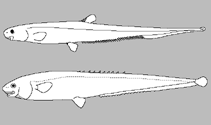
Etymology: Polyacanthonotus: Greek, poly = a lot of + Greek, akantha = thorn + Greek,noton = back (Ref. 45335).
Eponymy: Dr Nigel Robert Merrett (d: 1940) is a British zoologist and ichthyologist. [...] (Ref. 128868), visit book page.
Entorno: milieu / zona climática / rango de profundidad / gama de distribución
Ecología
marino batidemersal; rango de profundidad ? - 1409 m (Ref. 58018). Deep-water
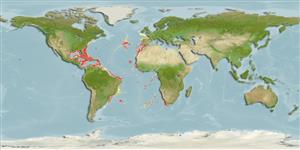
Western Atlantic: off the Bahamas.
Tamaño / Peso / Edad
Madurez: Lm ? range ? - ? cm
Max length : 27.0 cm TL macho / no sexado; (Ref. 4517)
Ciclo vital y comportamiento de apareamiento
Madurez | Reproducción | Puesta | Huevos | Fecundidad | Larva
McAllister, D.E., 1990. A working list of fishes of the world. Copies available from D.E. McAllister, Canadian Museum of Nature, P.O. Box 3443, Ottawa, Ontario K1P 6P4, Canada. 2661 p. plus 1270 p. Index. (Ref. 27116)
Situación en la Lista Roja de la UICN (Ref. 130435: Version 2025-2 (Global))
Amenaza para el ser humano
Harmless
Usos humanos
Herramientas
Informes especiales
Descargar XML
Fuentes de Internet
Estimaciones basadas en modelos
Temperatura preferida (Referencia
123201): 6.2 - 14.7, mean 10 °C (based on 198 cells).
Índice de diversidad filogenética (Referencia
82804): PD
50 = 0.5626 [Uniqueness, from 0.5 = low to 2.0 = high].
Bayesian length-weight: a=0.00102 (0.00046 - 0.00225), b=3.06 (2.88 - 3.24), in cm total length, based on all LWR estimates for this body shape (Ref.
93245).
Nivel trófico (Referencia
69278): 3.2 ±0.5 se; based on size and trophs of closest relatives
Resiliencia (Referencia
120179): Medio, población duplicada en un tiempo mínimo de 1.4-4.4 años (Preliminary K or Fecundity.).
Vulnerabilidad pesquera (Ref.
59153): Low vulnerability (17 of 100).
🛈