>
Ceratodontiformes (Australian lungfishes) >
Protopteridae (African lungfishes)
Etymology: Protopterus: Greek, pro = first, in front of + Greek, pteron = wing, fin (Ref. 45335); dolloi: Named after Louis Dollo, for his work on the phylogeny of the lungfishes (Ref. 41613).
Eponymy: Dr Louis Antoine Marie Joséph Dollo (1857–1931) was a French-born Belgian palaeontologist, known for his work on fossil reptiles. [...] (Ref. 128868), visit book page.
More on author: Boulenger.
Umwelt: Milieu / Klimazone / Tiefenbereich / Verbreitungsgebiet
Ökologie
; süßwasser demersal. Tropical
Africa: widespread in the lower and middle Congo River basin (Ref. 3498, 40587, 81627, 104724). Also known from the Ogowe, Kouilou-Niari and Loeme rivers (Ref. 3498, 40587, 81627).
Größe / Gewicht / Alter
Geschlechtsreife: Lm ? range ? - ? cm
Max length : 130 cm TL Männchen/unbestimmt; (Ref. 3498); max. veröff. Gewicht: 11.0 kg (Ref. 41589)
Kurzbeschreibung
Bestimmungsschlüssel | Morphologie | Morphometrie
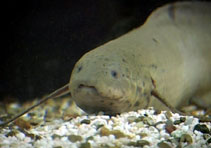
Diagnosis: Body cylindrical and more elongate than in other Protopterus species (Ref. 81627). Pectoral and pelvic fins filamentous (Ref. 40587). About 85-95 scales on the longitudinal line between operculum and anus (Ref. 104724).
Body shape (shape guide): elongated; Cross section: circular.
Obligate air-breathing (Ref. 126274); Protopterus dolloi is not aestivating in cocoons during the dry-season, because the habitat in which it lives is never completely dry (Ref. 81627); although it never lost the capability to aestivate (Ref. 40587). Therefore, the tunnel which it digs is not for hibernation but functions as a protected chamber during reproduction, which takes place in the dry season (Ref. 81627). The male guards the eggs and larvae in the nest, which is built in the mud of the swamps, while the females can be found in the open water of the rivers (Ref. 41587, 81627). The food of Protopterus dolloi are fishes and insects, but during the time of reproduction its food is more vegetarian (Ref. 40587, 46852).
Lebenszyklus und Paarungsverhalten
Geschlechtsreife | Fortpflanzung | Ablaichen | Eier | Fruchtbarkeit | Larven
Nests are found from June until October; the male guards the eggs and young (Ref. 40587).
Boden, G., 2007. Protopteridae. p. 165-167. In M.L.J. Stiassny, G.G. Teugels and C.D. Hopkins (eds.) The fresh and brackish water fishes of Lower Guinea, West-Central Africa. Volume I. Collection Faune et Flore tropicales 42. Institut de Recherche pour le Développement, Paris, France, Muséum National d’Histoire Naturelle, Paris, France, and Musée Royal de l’Afrique Centrale, Tervuren, Belgium. 800 pp. (Ref. 81627)
IUCN Rote Liste Status (Ref. 130435: Version 2025-2 (Global))
Bedrohung für Menschen
Harmless
Nutzung durch Menschen
Fischereien: weniger kommerziell
Tools
Zusatzinformationen
Download XML
Internet Quellen
Schätzungen auf der Grundlage von Modellen
Phylogenetischer Diversitätsindex (Ref.
82804): PD
50 = 0.6562 [Uniqueness, from 0.5 = low to 2.0 = high].
Bayesian length-weight: a=0.00380 (0.00151 - 0.00959), b=3.10 (2.88 - 3.32), in cm total length, based on LWR estimates for this (Sub)family-body shape (Ref.
93245).
Trophische Ebene (Ref.
69278): 3.2 ±0.40 se; based on food items.
Widerstandsfähigkeit (Ref.
120179): sehr niedrig, Verdopplung der Population dauert mehr als 14 Jahre. (Assuming tmax > 30).
Anfälligkeit der Fischerei (Ref.
59153): Very high vulnerability (78 of 100).
🛈
Nährstoffe (Ref.
124155): Calcium = 34.6 [7.9, 105.9] mg/100g; Iron = 0.98 [0.38, 4.94] mg/100g; Protein = 3.18 [0.00, 7.00] %; Omega3 = 0.247 [0.082, 0.731] g/100g; Selenium = 78.3 [23.7, 253.2] μg/100g; VitaminA = 18.9 [6.9, 48.5] μg/100g; Zinc = 1.29 [0.66, 2.50] mg/100g (wet weight);