>
Gobiiformes (Gobies) >
Gobiidae (Gobies) > Gobionellinae
Etymology: Redigobius: Latin,. Redere = to come back + Latin, gobius = gudgeon.
More on author: Herre.
Entorno: milieu / zona climática / rango de profundidad / gama de distribución
Ecología
marino; agua dulce; salobre bentopelágico; anfidromo (Ref. 59012); rango de profundidad 0 - 5 m (Ref. 86942). Tropical; 21°C - 28°C (Ref. 12468); 35°N - 6°N
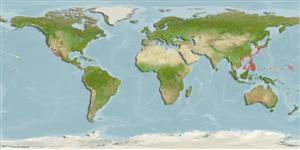
Asia and Oceania: Japan southward to the Philippines, Indonesia, New Guinea and Australia. Reported from Africa: south to Coffee Bay, South Africa (Ref. 2798) and Seychelles (Ref. 4343). Widely distributed over the West tropical Pacific, from Japan to the Philippines, Indonesia, New-Guinea, North of Australia, Vanuatu and New Caledonia (Ref. 87781). The Redigobius genus is actually being revised and especially the bikolanus group that should be splitted into several taxa, leading to a revision of the group distribution also (Ref. 87781).
Tamaño / Peso / Edad
Madurez: Lm ? range ? - ? cm
Max length : 4.9 cm TL macho / no sexado; (Ref. 11344)
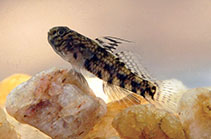
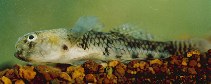
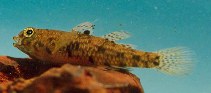
Espinas dorsales (total) : 7; Radios blandos dorsales (total) : 6 - 8; Espinas anales: 1; Radios blandos anales: 6 - 8. Distinguished by the following characteristics: 2-3 dark spot at caudal base (Ref. 2798); Redigobius with dusky scale margins forming network pattern; side of body variably marked with series of dark brown blotches or bars, one blackish, slightly oblique, narrow bar on side of body, second blackish narrow bar present on lower half of body; four distinct dark brown to blackish spots along mid-ventral line at anal fin; second dorsal rays I,6-8; anal rays I,6-8; pectoral rays 14-18; longitudinal scales 21-27; TRB 6 1/2 to 8 1/2; predorsal scales 5-8 (Ref. 84480).
Body shape (shape guide): fusiform / normal.
Adults inhabit creeks, rivers and brackish estuaries (Ref. 2847, 44894). Found in tidal streams (Ref. 4343, 44894). Sometimes seen upstream a short distance from the tidal zone. Feed on small fishes and invertebrates. Not seen in markets (Ref. 12693).
Ciclo vital y comportamiento de apareamiento
Madurez | Reproducción | Puesta | Huevos | Fecundidad | Larva
Larson, H.K., 2001. A revision of the gobiid fish genus Mugilogobius (Teleostei: Gobioidei), and its systematic placement. Rec. West. Aust. Mus. (Suppl. No. 62):1-233. (Ref. 43716)
Situación en la Lista Roja de la UICN (Ref. 130435: Version 2025-2 (Global))
Amenaza para el ser humano
Harmless
Usos humanos
Pesquerías: pesquerías de subsistencia
Herramientas
Informes especiales
Descargar XML
Fuentes de Internet
Estimaciones basadas en modelos
Temperatura preferida (Referencia
123201): 22.4 - 29, mean 28.4 °C (based on 586 cells).
Índice de diversidad filogenética (Referencia
82804): PD
50 = 0.5000 [Uniqueness, from 0.5 = low to 2.0 = high].
Bayesian length-weight: a=0.01023 (0.00452 - 0.02316), b=3.00 (2.81 - 3.19), in cm total length, based on LWR estimates for this (Sub)family-body shape (Ref.
93245).
Nivel trófico (Referencia
69278): 3.3 ±0.43 se; based on food items.
Resiliencia (Referencia
120179): Medio, población duplicada en un tiempo mínimo de 1.4-4.4 años (Fec=1,000).
Vulnerabilidad pesquera (Ref.
59153): Low vulnerability (10 of 100).
🛈