Ambiente: milieu / zona climática / intervalo de profundidade / gama de distribuição
Ecologia
; Água doce demersal; anádromo (Ref. 51243). Subtropical; 2°C - 15°C (Ref. 11241); 47°N - 43°N, 7°E - 20°E
Europe: Adriatic basin from Po (only northern tributaries) to Soca and Rizana drainages (Italy, Slovenia). Introduced in Tevere drainage in Italy. Molecular data suggest that populations identified as Salmo marmoratus from Neretva drainage (Bosnia-Herzegovina, Croatia) and most likely those from Lake Skadar basin and Drin to Shkumbin drainages (Montenegro, Albania, Kosovoa, Macedonia) represent another species, as yet unidentified. Records from Croatia, Montenegro, Bosnia and Albania may be other subspecies of Adriatic trout and not of this marble trout (Lucijan Rejec, lrejec@ribiska-druzina-tolmin.si, pers.comm. 07/09).
Tamanho / Peso / Idade
Maturidade: Lm ? range ? - ? cm
Max length : 120 cm SL macho/indeterminado; (Ref. 59043); peso máx. Publicado: 50.0 kg (Ref. 59043); Idade máx. registada: 10 anos (Ref. 59043)
Descrição breve
Chaves de identificação | Morfologia | Morfometria
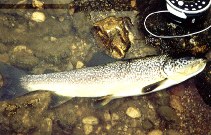
Distinguished from all congeners in Adriatic basin by having the following unique characters: body silvery to olive-green with irregular brown lines forming a marbled pattern; and no parr marks in individuals larger than 6 cm SL. Differs further by the combination of the following characters: red spots confined to lateral line, absent in some individuals and populations; opercle with brownish blotches or lines; head length 22-25% SL; eye diameter 1.7-2.2 times in interorbital distance, 3.1-4.3 times in postorbital length (at 25-35 cm SL) (Ref. 59043).
Body shape (shape guide): fusiform / normal.
Inhabits cold streams and rivers in montane and piedmont landscapes with temperature usually not rising above 15° C during summer (Ref. 59043). Occurs over sandy and gravelly bottoms of running or standing clean and cold waters in the upper courses of Alpine rivers and glacial lakes (Ref. 12291). Feeds on a wide variety of aquatic and terrestrial invertebrates, shifting to fish diet when adult. Spawns in gravel of rivers and streams with swift water (0.4-0.5 m/s) at moderate depth (0.6-0.8 m). Lives up to at least 10 years. Threatened due to hybridization with introduced Salmo trutta and Salmo cenerinus, pollution, overfishing and river regulation. Only a few pure populations remain and stocking of pure strains has improved the situation. Conservation status is under least concern category, but might return to a threatened category if conservation measures end (Ref. 59043).
Ciclo de vida e comportamento de acasalamento
Maturidade | Reprodução | Desova | Ovos | Fecundidade | Larvas
Does not undertake spawning migrations or undertake migrations only at very short distances. Individuals foraging in lakes move to lake tributaries to spawn. Males begin occupying spawning grounds about one week before females. Eggs hatch in about 45 days. Alevins commence feeding 59-63 days after spawning at 10° C (Ref. 59043).
Kottelat, M. and J. Freyhof, 2007. Handbook of European freshwater fishes. Publications Kottelat, Cornol and Freyhof, Berlin. 646 pp. (Ref. 59043)
Categoria na Lista Vermelha da IUCN (Ref. 130435: Version 2025-2 (Global))
Ameaça para o homem
Harmless
Utilização humana
Pescarias: espécies comerciais; Aquacultura: espécies comerciais; peixe desportivo: sim
Ferramentas
Relatórios especiais
Descarregue XML
Fontes da internet
Estimativas baseadas em modelos
Índice de diversidade filogenética (Ref.
82804): PD
50 = 0.5000 [Uniqueness, from 0.5 = low to 2.0 = high].
Bayesian length-weight: a=0.01047 (0.00486 - 0.02255), b=3.03 (2.86 - 3.20), in cm total length, based on LWR estimates for this Genus-body shape (Ref.
93245).
Nível Trófico (Ref.
69278): 4.0 ±0.63 se; based on food items.
Generation time: 3.7 ( na - na) years. Estimated as median ln(3)/K based on 2
growth studies.
Resiliência (Ref.
120179): Médio, tempo mínimo de duplicação da população 1,4 - 4,4 anos (Preliminary K or Fecundity.).
Vulnerabilidade da pesca (Ref.
59153): Very high vulnerability (88 of 100).
🛈