>
Eupercaria/misc (Various families in series Eupercaria) >
Labridae (Wrasses) > Scarinae
Etymology: Scarus: Greek, skaros = a fish described by anciente writers as a parrot fish; 1601 (Ref. 45335).
More on author: Kner.
Milieu: milieu / Klimaatzone / Diepte / verspreidingsgebied
Ecologie
marien rifbewoner; diepte 0 - 30 m (Ref. 128797), usually 2 - 15 m (Ref. 37816). Tropical; 30°N - 24°S
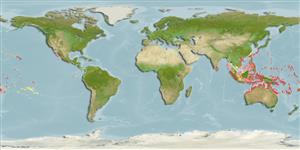
Pacific Ocean: Christmas Island in the eastern Indian Ocean (Ref. 30874), then from the Philippines to Samoa, north to the Ryukyu Islands, south to the southern Great Barrier Reef.
Grootte / Gewicht / Leeftijd
Maturiteit: Lm ? range ? - ? cm
Max length : 30.0 cm TL mannelijk / geslacht onbekend; (Ref. 2334)
Korte beschrijving
Determinatiesleutels | Morfologie | Morfometrie
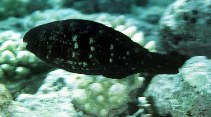
Dorsale stekels (totaal) : 9; Dorsale zachte stralen (totaal) : 10; Anale stekels: 3; Anale zachte stralen: 9. Males distinct and head looks bright yellow underwater; females drab with white teeth and some pale spots (Ref. 48636). Scales large. 4 median predorsal scales; a transverse pair of smaller scales which overlap medially in mid-dorsal line located directly anterior to 1st median scale; 3 scale rows on cheek, lower row with 1-2 (usually 2) scales. Caudal fin slightly rounded to truncate in initial phase; moderately to deeply emarginate in terminal phase. Adults in initial phase without canines on upper plate, 1 on lower; terminal-phase fish with 1-2 canines on upper and lower plates. Lips largely or entirely cover dental plates.
Body shape (shape guide): elongated; Cross section: compressed.
Inhabits coral-rich areas of outer lagoon and seaward reefs (Ref. 9710). Usually solitary (Ref. 9710). Females usually in small groups with a male nearby; they may mix with females of similar species (Ref. 48636). An uncommon fish patchily distributed through much of its range.
Levenscyclus en paargedrag
Maturiteit | Voortplanting | Paaien | Eieren | Fecunditeit | Larven
Oviparous, distinct pairing during breeding (Ref. 205).
Randall, J.E., G.R. Allen and R.C. Steene, 1990. Fishes of the Great Barrier Reef and Coral Sea. University of Hawaii Press, Honolulu, Hawaii. 506 p. (Ref. 2334)
Status op de Rode Lijst van het IUCN (Ref. 130435: Version 2025-2 (Global))
Gevaar voor de mens
Harmless
Gebruik door de mens
Tools
Speciale rapporten
Download XML
Internetbronnen
Schattingen op basis van modellen
Gewenste temperatuur (Ref.
123201): 25 - 29.3, mean 28.5 °C (based on 2066 cells).
Fylogenetische diversiteitsindex (Ref.
82804): PD
50 = 0.5000 [Uniqueness, from 0.5 = low to 2.0 = high].
Bayesian length-weight: a=0.01122 (0.00482 - 0.02609), b=3.06 (2.88 - 3.24), in cm total length, based on LWR estimates for this Genus-body shape (Ref.
93245).
Trofisch niveau (Ref.
69278): 2.0 ±0.00 se; based on food items.
Weerstandsvermogen (Ref.
120179): Gemiddeld, minimale populatieverdubbelingstijd 1,4-4,4 jaar (Preliminary K or Fecundity.).
Kwetsbaarheid van de visserij (Ref.
59153): Low vulnerability (20 of 100).
🛈
Voedingsstoffen (Ref.
124155): Calcium = 56.3 [31.4, 96.2] mg/100g; Iron = 0.782 [0.504, 1.329] mg/100g; Protein = 18.1 [16.0, 19.9] %; Omega3 = 0.058 [0.034, 0.099] g/100g; Selenium = 20.3 [10.3, 37.1] μg/100g; VitaminA = 50.8 [12.7, 199.7] μg/100g; Zinc = 2.5 [1.8, 3.4] mg/100g (wet weight);