Klassifizierung / Names
Namen | Synonyme | Catalog of Fishes(Gattung, Arten) | ITIS | CoL | WoRMS | Cloffa
>
Perciformes/Scorpaenoidei (Scorpionfishes) >
Sebastidae (Rockfishes, rockcods and thornyheads) > Sebastinae
Etymology: Sebastes: Greek, sebastes = august, venerable (Ref. 45335); variabilis: Name is presumed to be referring to the wide range of body color of the species.
More on author: Pallas.
Umwelt: Milieu / Klimazone / Tiefenbereich / Verbreitungsgebiet
Ökologie
seewasser demersal; tiefenbereich 6 - 675 m (Ref. 53613), usually 100 - 300 m (Ref. 53613). Subtropical
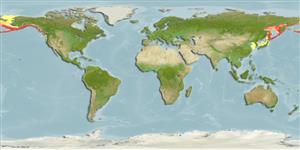
North Pacific: Japan, east coast of Kamchatka to Cape Ol'utorskii in western Bering Sea, along the Aleutian Islands to 60°N in the eastern Bering Sea, through the Gulf of Alaska south to Johnstone Strait, British Columbia and to central Oregon.
Länge bei der ersten Reifung / Größe / Gewicht / Alter
Geschlechtsreife: Lm 36.5 range ? - ? cm
Max length : 43.1 cm SL Männchen/unbestimmt; (Ref. 53613); max. veröff. Alter: 50 Jahre (Ref. 93327)
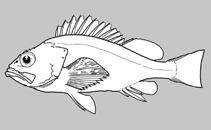
Rückenflossenstacheln (insgesamt) : 13 - 14; Rückenflossenweichstrahlen (insgesamt) : 13 - 16; Afterflossenstacheln: 3; Afterflossenweichstrahlen: 7 - 9; Wirbelzahl: 28 - 29. This species is distinguished by the following characters: body light yellow to greenish brown to gray, typically greenish brown, with orange flecks present on sides, distinctly light ventrally above anal-fin base and on ventral pectoral-fin rays; peritoneum light gray to jet black; strong symphyseal knob; extrinsic swimbladder muscle with a single section of striated muscle, lacking anterior fascia, otherwise of type I (a-z) of Hallacher (1974); lateral-line pores 43-54, scales 47-63; pectoral-fin rays 16-19; anal-fin rays 7-9; dorsal-fin rays 13-16; vertebrae total 28-29 (11-12 + 16-18) (Ref. 53613).
Collection depth between 6-370 m, deepest recorded depth at 675 m. Large adults common along the edge of the continental shelf at 100-300 m where the species is targeted for commercial use. Captured in the offshore trawl fishery. Males and females captured by trawl surveys vary widely in maturity during the summer (May-July) (Ref. 53613).
Orr, J.W. and J.E. Blackburn, 2004. The dusky rockfishes (Teleostei: Scorpaeniformes) of the North Pacific Ocean: resurrection of Sebastes variabilis (Pallas, 1814) and a redescription of Sebastes ciliatus (Tilesius, 1813). Fish. Bull. 102:328-348. (Ref. 53613)
IUCN Rote Liste Status (Ref. 130435: Version 2025-2 (Global))
Bedrohung für Menschen
Harmless
Nutzung durch Menschen
Fischereien: kommerziell
Tools
Zusatzinformationen
Download XML
Internet Quellen
Schätzungen auf der Grundlage von Modellen
Bevorzugte Temperatur (Ref.
123201): 0.5 - 6.2, mean 3.2 °C (based on 368 cells).
Phylogenetischer Diversitätsindex (Ref.
82804): PD
50 = 0.5000 [Uniqueness, from 0.5 = low to 2.0 = high].
Bayesian length-weight: a=0.00977 (0.00589 - 0.01620), b=3.08 (2.94 - 3.22), in cm total length, based on LWR estimates for this species & Genus-body shape (Ref.
93245).
Trophische Ebene (Ref.
69278): 3.7 ±0.5 se; based on size and trophs of closest relatives
Widerstandsfähigkeit (Ref.
120179): sehr niedrig, Verdopplung der Population dauert mehr als 14 Jahre. (K=0.2; tm=9.2; tmax=50).
Prior r = 0.19, 95% CL = 0.13 - 0.29, Based on 2 full stock assessments.
Anfälligkeit der Fischerei (Ref.
59153): Moderate vulnerability (41 of 100).
🛈