>
Salmoniformes (Salmons) >
Salmonidae (Salmonids) > Coregoninae
Etymology: Stenodus: Greek, stenos = narrow + Greek, odous = teeth (Ref. 45335); leucichthys: leucichthys meaning white fish (Ref. 1998).
Taxonomic Remarks
Stenodus nelma (Pallas, 1773) is a valid species according to Kottelat and Freyhof (2007: Ref. 82592). The corresponding species summary page will be created in the future.
Ambiente: milieu / zona climática / intervalo de profundidade / gama de distribuição
Ecologia
marinhas; Água doce; estuarina demersal; anádromo (Ref. 138280); intervalo de profundidade 10 - ? m (Ref. 4779). Boreal; 73°N - 58°N, 36°E - 111°W
North America: Arctic drainages from Anderson River in Northwest Territories, Canada to Kuskokwim River (Bering Sea tributary) in Alaska. Upstream in Mackenzie River and Yukon River drainages to British Columbia, Canada (Ref. 5723). Eurasia: Caspian Sea (common in central and southern Caspian in summer), Volga, Ural and Terak drainages (Ref. 59043). Hybridization with Coregonus nelsoni, Coregonus autumnalis and Coregonus muksun are due more to the broadcasting of eggs and sperm rather than pairing between species or genera (Ref. 27547).
Comprimento na primeira maturidade / Tamanho / Peso / Idade
Maturidade: Lm 72.5, range 70 - 75 cm
Max length : 150 cm TL macho/indeterminado; (Ref. 4574); common length : 61.0 cm TL macho/indeterminado; (Ref. 12193); peso máx. Publicado: 40.0 kg (Ref. 10318); Idade máx. registada: 22 anos (Ref. 4576)
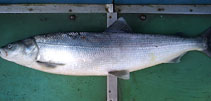
Espinhos dorsais (total) : 0; Raios dorsais moles (total) : 11 - 19; Espinhos anais: 0; Raios anais moles: 14 - 19; Vértebras: 63 - 69. Distinguished by its large mouth, the protruding lower jaw, and the presence of only 13 to 17 gill rakers on the lower limb of the first gill arch (Ref. 27547). Dorsal fin high and pointed; pelvic fins with well developed axillary process (Ref. 27547). Generally silvery, with the back usually rather green, blue or pale brown; silvery white below; dorsal and caudal fins have dusky margins, other fins pale (Ref. 27547).
Body shape (shape guide): fusiform / normal.
Nerito-pelagic (Ref. 58426). Adults occur in coastal brackish waters near mouths of rivers, but usually in rivers or some land-locked lakes (Ref. 4779). At the sea, they are found throughout basin in pelagic zone with temperatures below 18° C and 20-50 m deep (Ref. 59043). Juveniles and adults overwinter and forage at the sea. Encountered in large lowland rivers during migration (Ref. 59043). Adults feed mostly on small fishes; young eat aquatic insect larvae and planktonic crustaceans (Ref. 4779). During spawning migration, it feeds little if at all (Ref. 27547). Mature individuals spawn on gravel shallows (Ref. 59043). Flesh is white, sweet and slightly oily (Ref. 27547). Sold fresh or frozen.
Upstream migration from wintering areas begins at ice break-up. Early upstream movement may be associated with feeding, but movement soon becomes a definite migration to the spawning area. Spawning begins at dusk, and continuing well into the night. A female accompanied by a male, swims to the surface near the upstream end of the spawning ground. She rapidly moves across the current, extruding her eggs. The male, stays below the female so that as the eggs sink, sperm released, fertilizes the eggs. After completing a spawning pass, the female drifts downstream. She may repeat the spawning act over the downstream portion of the spawning area or may move upstream to the head of the grounds before releasing more eggs. Following spawning, there is a fairly rapid downstream migration to wintering grounds (Ref. 27547). It is not certain if spawning occurs annually or at longer intervals (Ref. 27547). Russian fish appear to spawn only every third or fourth year (Ref. 28219). Spawning frequency at Selawik, Alaska may be every other year (Ref. 27547).
Svetovidov, A.N., 1984. Salmonidae. p. 373-385. In P.J.P. Whitehead, M.-L. Bauchot, J.-C. Hureau, J. Nielsen and E. Tortonese (eds.) Fishes of the north-eastern Atlantic and the Mediterranean. UNESCO, Paris. vol. 1. (Ref. 4779)
Categoria na Lista Vermelha da IUCN (Ref. 130435: Version 2025-2 (Global))
Ameaça para o homem
Harmless
Utilização humana
Pescarias: pouco comercial; Aquacultura: espécies comerciais; peixe desportivo: sim
Ferramentas
Relatórios especiais
Descarregue XML
Fontes da internet
Estimativas baseadas em modelos
Índice de diversidade filogenética (Ref.
82804): PD
50 = 0.7500 [Uniqueness, from 0.5 = low to 2.0 = high].
Bayesian length-weight: a=0.00479 (0.00394 - 0.00581), b=3.18 (3.13 - 3.23), in cm total length, based on LWR estimates for this species (Ref.
93245).
Nível Trófico (Ref.
69278): 4.1 ±0.74 se; based on food items.
Generation time: 14.7 (8.1 - 19.6) years. Estimated as median ln(3)/K based on 10
growth studies.
Resiliência (Ref.
120179): Baixo, tempo mínimo de duplicação da população 4,5 - 14 anos (K=0.05-0.10; tm=5-12; tmax=22; Fec=80,000).
Prior r = 0.42, 95% CL = 0.28 - 0.63, Based on 2 data-limited stock assessments.
Vulnerabilidade da pesca (Ref.
59153): High to very high vulnerability (74 of 100).
🛈
Nutrientes (Ref.
124155): Calcium = 10.3 [5.6, 24.2] mg/100g; Iron = 0.409 [0.208, 0.798] mg/100g; Protein = 18.8 [17.2, 20.2] %; Omega3 = 0.565 [0.227, 1.537] g/100g; Selenium = 17.9 [7.4, 43.7] μg/100g; VitaminA = 8.75 [1.47, 53.62] μg/100g; Zinc = 0.304 [0.204, 0.438] mg/100g (wet weight); based on
nutrient studies.