>
Salmoniformes (Salmons) >
Salmonidae (Salmonids) > Thymallinae
Etymology: Thymallus: Greek, thymallos, -ou = a kind of fish similar to salmon (Ref. 45335); tugarinae: Named for Professor Polina Yakovlevna Tugarina, Irkutsk State University.
Eponymy: Praskov’ya (Polina) Yakovlevna Tugarina (1928–2004) was a Russian ichthyologist as well as being a ‘renowned’ researcher of the graylings of Siberia and Russia’s Far East, especially in the Lake Baikal Region. [...] (Ref. 128868), visit book page.
Ambiente: milieu / zona climática / intervalo de profundidade / gama de distribuição
Ecologia
; Água doce pelágico(a,os,as). Temperate
Asia: Lower Amur River Basin in Russia.
Tamanho / Peso / Idade
Maturidade: Lm ? range ? - ? cm
Max length : 25.5 cm SL macho/indeterminado; (Ref. 57969); Idade máx. registada: 6 anos (Ref. 92308)
Descrição breve
Chaves de identificação | Morfologia | Morfometria
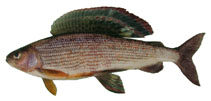
Vértebras: 49 - 55. The species is characterized by the following: Pored lateral line scales 75-91; unbranched rays in first dorsal fin 8-12, in second dorsal fin 13-17, total dorsal fin rays 23-26; number of vertebrae excluding urostyle 49-55; pyloric caeca 11-20; a wide red to maroon edging with the width 5-6 mm is seen along the upper margin of the dorsal fin, broadening towards the posterior end of the fin (in large males it may be 10 mm in width or more); below it , parallel with the edging, there are 4-5 rows (bands) of same-color spots; the upper row is slightly separated
from the edging and the bands below, and consists of the largest, slightly horizontally elongated oval spots; the lowest row of the spots, adjoined to the fin base, is weakly pronounced; bright orange sinuous stripes between the scale rows going along the body.; upper jaw overlaps with the anterior margin of the eye; length of dorsal fin base is from 25.3 to 33.3% SL; body significantly compressed laterally, its average depth is 22.9% SL; no teeth on vomer (Ref. 57969).
Body shape (shape guide): fusiform / normal.
The species spawns in rivers of the Amur Basin from the middle to the end of May, 7-10 days
before the T. grubei flavomaculatus. The autumn downstream migration in tributaries of
the lower Amur takes place from September to October. The range of the food components of the Lower Amur grayling in the Anyui River in July is represented by various zoobenthos organisms. The most weight part in the food boluses of fish older than the age 3+ is
represented by mayfly and stonefly larvae, imago caddis and bugs. The composition and the frequency of occurrence of different organisms in the food boluses of the Lower Amur grayling. Comparison of the feeding spectra in the Lower Amur and yellow-spotted graylings caught in the same stations did not reveal any significant differences in the diversity of the food components (Ref. 57969).
Ciclo de vida e comportamento de acasalamento
Maturidade | Reprodução | Desova | Ovos | Fecundidade | Larvas
Knizhin, I.B., A.L. Antonov, S.N. Safronov and S.J. Weiss, 2007. New species of Grayling Thymallus tugarinae sp. nova (Thymallidae) from the Amur River Basin. J. Ichthyol. 47(2):123-139. (Ref. 57969)
Categoria na Lista Vermelha da IUCN (Ref. 130435: Version 2025-2 (Global))
Ameaça para o homem
Harmless
Utilização humana
Ferramentas
Relatórios especiais
Descarregue XML
Fontes da internet
Estimativas baseadas em modelos
Índice de diversidade filogenética (Ref.
82804): PD
50 = 0.5000 [Uniqueness, from 0.5 = low to 2.0 = high].
Bayesian length-weight: a=0.00646 (0.00351 - 0.01187), b=3.06 (2.89 - 3.23), in cm total length, based on LWR estimates for this species & (Sub)family-body (Ref.
93245).
Nível Trófico (Ref.
69278): 3.2 ±0.4 se; based on size and trophs of closest relatives
Resiliência (Ref.
120179): Médio, tempo mínimo de duplicação da população 1,4 - 4,4 anos (Preliminary K or Fecundity.).
Vulnerabilidade da pesca (Ref.
59153): Low vulnerability (21 of 100).
🛈