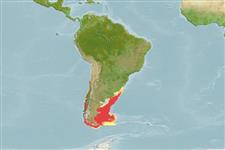
Ambiente: milieu / zona climática / intervalo de profundidade / gama de distribuição
Ecologia
marinhas demersal; intervalo de profundidade ? - 40 m (Ref. 120403). Temperate; 4°C - 19°C (Ref. 104541); 18°S - 57°S, 75°W - 52°W
Southeast Pacific: central Chile to the Strait of Magellan.
Comprimento na primeira maturidade / Tamanho / Peso / Idade
Maturidade: Lm 103.5, range 94 - 100 cm
Max length : 152 cm TL macho/indeterminado; (Ref. 120403)
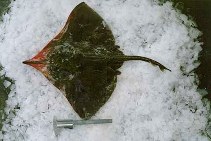
This medium-sized speies of Dipturus (up to at least 118.0 cm TL) is distinguished from its congeners by the following set of characters: when fresh, the dorsal surface of body is plain brownish to greyish, with some lighter small spots randomly distributed dorsally; one red to purple ocellus over center of each pectoral fin; ocelli with well-defined margins, irregular in shape, but often indistinguishable in fixed specimens; ventrally, white to grey with lighter patches over area of gill openings and beneath mouth; area flanking rostral cartilage membranous and slightly translucent and opaque and yellowish when fixed. Further differs by having a relatively broad disc with angular apices, its width 76.4 (75.0; 77.0) % TL; snout relatively short and broad; tail longer in males (42.2 [40.8] % TL) than in female voucher ([38.8] % TL); ventral head length 35.1 (34.2; 37.7) % TL; preorbital snout length 2.4 (2.9; 2.9) times distance between orbits; orbit diameter 0.5 (0.5; 0.6) of inter-orbital width; in males, the dorsal surface of disc and tail with central longitudinal band of dermal denticles extending from anterior margin of rostral cartilage to tail, including anterior margins of dorsal and caudal fins; a thin band of dermal denticles at anterior margins of pectoral fins, extending from anterior fontanelle to front line of alar thorn patches; dorsal surface of disc and tail of females covered with small dermal denticles, except for external margins of pectoral fins, pelvic fins, and area surrounding caudo-central thorns; with orbital thorns; a single nuchal thorn is often absent; both sexes without scapular thorns; a patch of malar thorns only in adult males; alar thorns only in adult males; medial-dorsal and lateral-dorsal thorns may be present in large specimens, especially in large females; small central-caudal thorns mostly arranged in longitudinal pairs in males and females, with two additional longitudinal rows of fine, sharp and posteriorly oriented lateral-caudal thorns may be present in large specimens; ventral sensory pores are small, distinct, black-edged, most abundant on snout and around mouth, scattered over area between gill openings, sparsely spaced on abdominal area and pectoral fins (Ref. 120403).
Cross section: flattened.
Oviparous (Ref. 50449). Reported size at hatching and incubation period 17.2 cm TL and 252 days, respectively (Ref. 120403). Eggs have horn-like projections on the shell (Ref. 205). Inhabits sandy and muddy bottoms at depths (Ref. 104541).
Ciclo de vida e comportamento de acasalamento
Maturidade | Reprodução | Desova | Ovos | Fecundidade | Larvas
Oviparous, paired eggs are laid. Embryos feed solely on yolk (Ref. 50449). Eggs have horn-like projections on the shell (Ref. 205).
Concha, F.J., J. Caira, D.A. Ebert and J.H.W. Pomperi, 2019. Redescription and taxonomic status of Dipturus chilensis (Guichenot, 1848), and description of Dipturus lamillai sp. nov. (Rajiformes: Rajidae), a new species of long-snout skate from the Falkland Islands. Zootaxa 4590(5):501-524. (Ref. 120403)
Categoria na Lista Vermelha da IUCN (Ref. 130435: Version 2025-2 (Global))
Ameaça para o homem
Harmless
Utilização humana
Pescarias: espécies comerciais
Ferramentas
Relatórios especiais
Descarregue XML
Fontes da internet
Estimativas baseadas em modelos
Temperatura preferida (Ref.
123201): 4.5 - 10.6, mean 6.7 °C (based on 334 cells).
Índice de diversidade filogenética (Ref.
82804): PD
50 = 0.5625 [Uniqueness, from 0.5 = low to 2.0 = high].
Bayesian length-weight: a=0.00302 (0.00141 - 0.00645), b=3.24 (3.07 - 3.41), in cm total length, based on LWR estimates for this (Sub)family-body shape (Ref.
93245).
Nível Trófico (Ref.
69278): 4.5 ±0.6 se; based on diet studies.
Generation time: 9.5 (8.1 - 12.6) years. Estimated as median ln(3)/K based on 13
growth studies.
Resiliência (Ref.
120179): Baixo, tempo mínimo de duplicação da população 4,5 - 14 anos (Fec assumed to be <100).
Vulnerabilidade da pesca (Ref.
59153): Very high vulnerability (90 of 100).
🛈
Nutrientes (Ref.
124155): Calcium = 3.18 [0.45, 55.95] mg/100g; Iron = 0.198 [0.018, 2.222] mg/100g; Protein = 15.2 [12.7, 18.3] %; Omega3 = 0.698 [0.304, 1.673] g/100g; Selenium = 18.6 [3.7, 89.1] μg/100g; VitaminA = 4.17 [0.30, 53.72] μg/100g; Zinc = 0.25 [0.02, 2.75] mg/100g (wet weight); based on
nutrient studies.